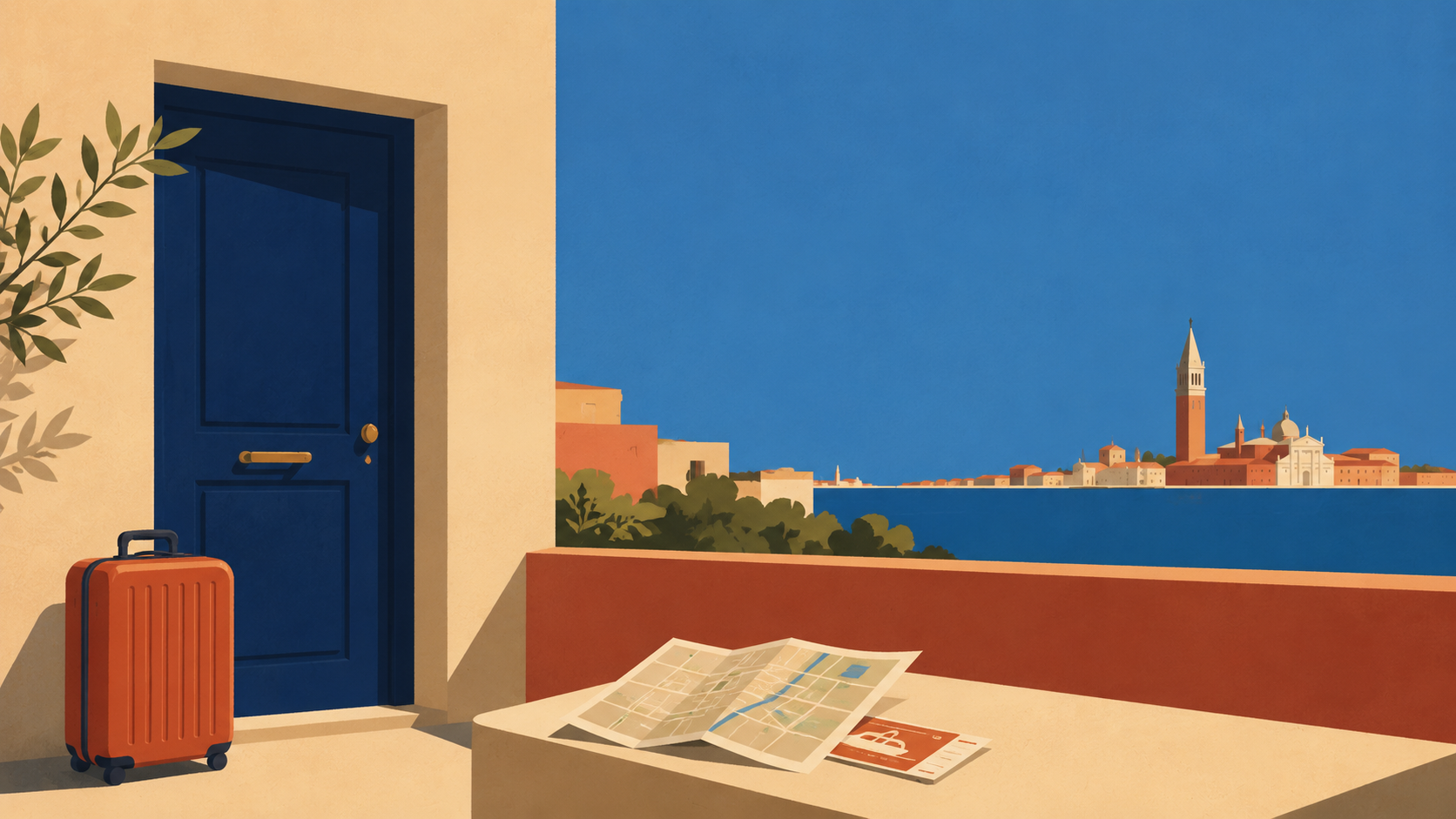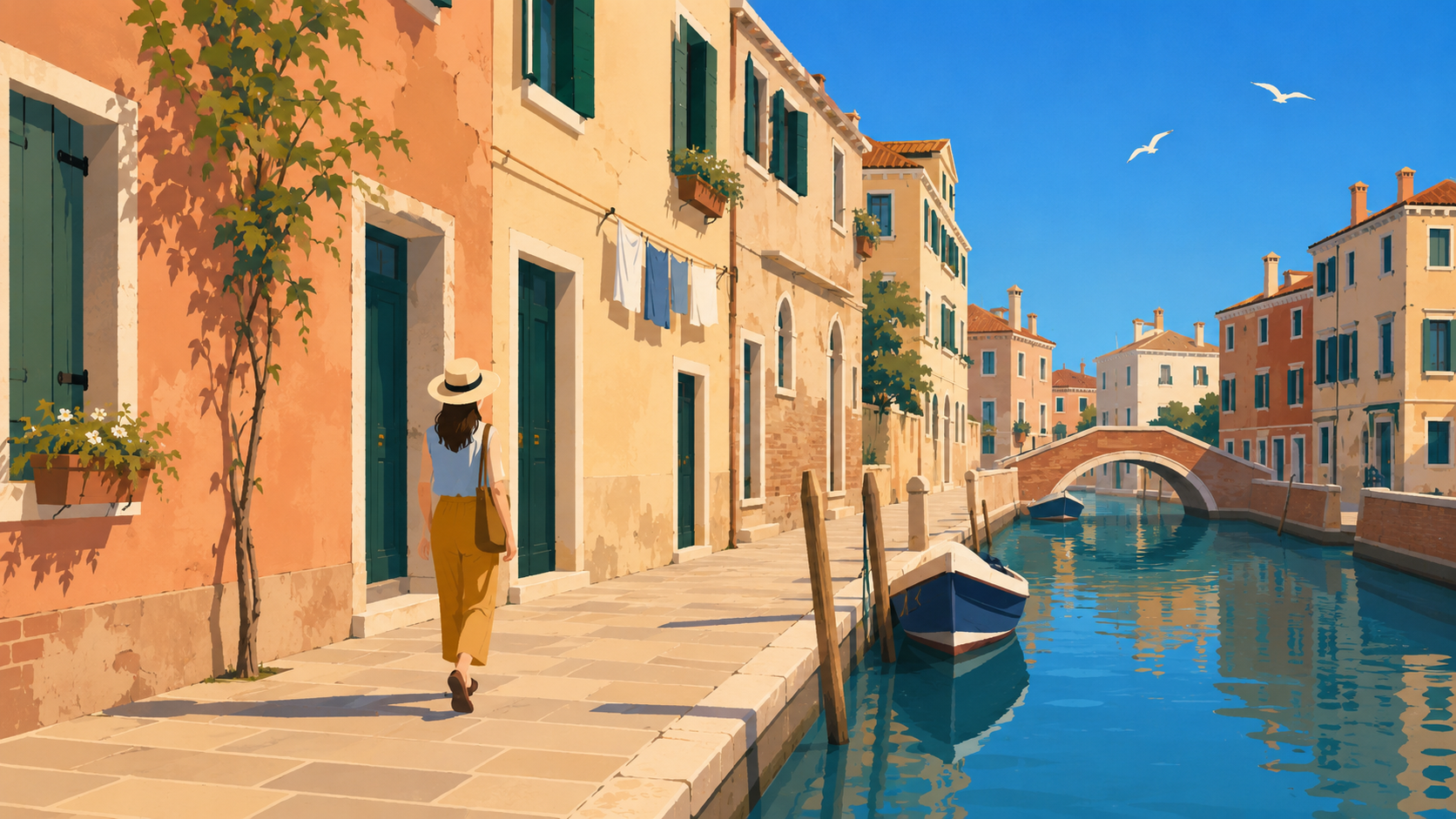
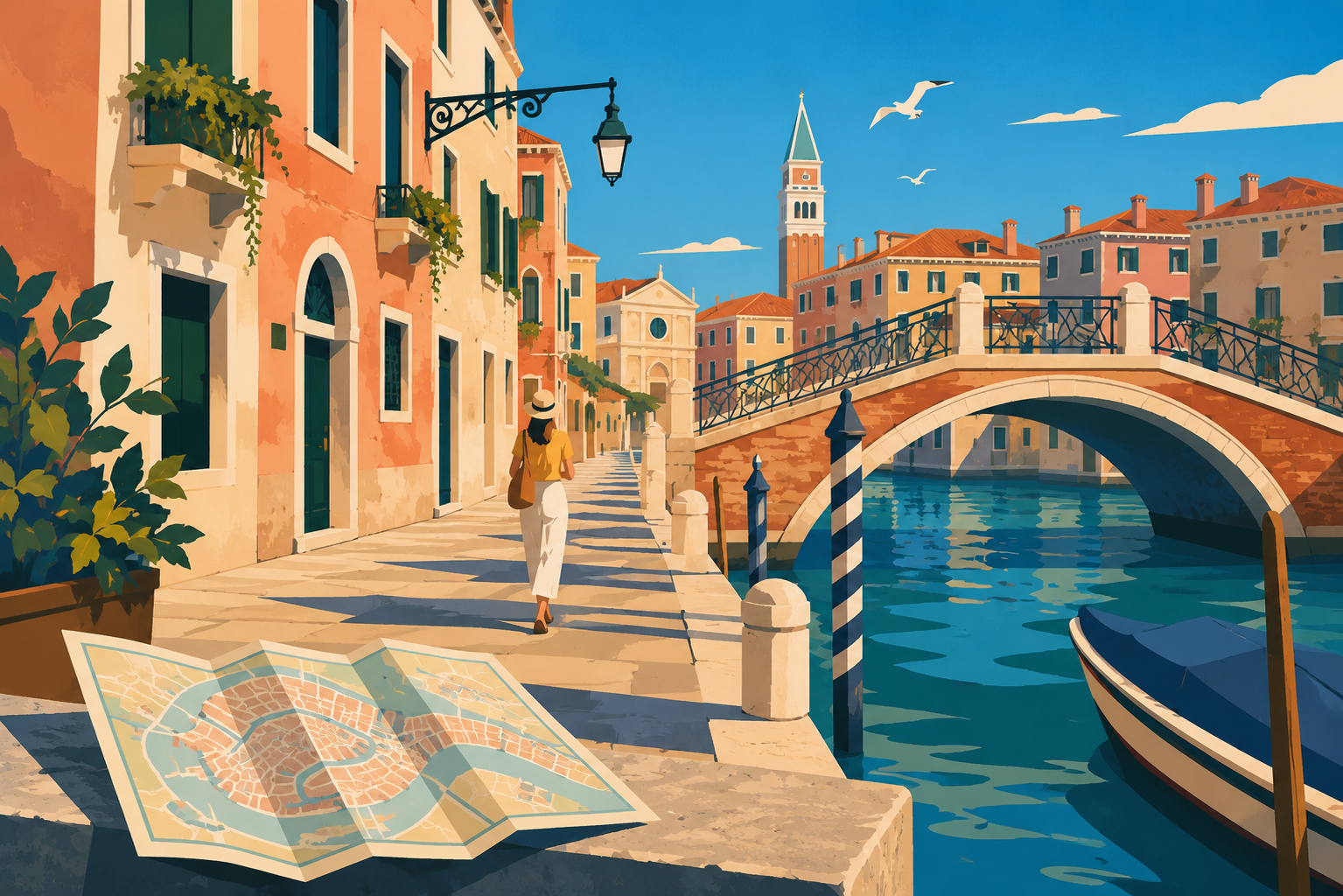

Your first encounter with Venice often begins in a very ordinary moment: stepping out of the railway station, crossing a bridge, getting off a vaporetto or walking along a canal with a map still open on your phone. Then, within minutes, you realise that moving through this city is not merely a way of getting from one place to another. The journey is already part of the visit.
Any itinerary for seeing Venice in two days should begin with that idea. Two days are enough to encounter the city’s most important places and begin to understand its character, but not enough to collect every museum, every island and every famous viewpoint. Trying to do so usually means crossing Venice while watching the time more closely than the canals.
The route below is intended for first-time visitors looking for balance: St Mark’s Square and the Doge’s Palace, certainly, but also a campo where you can pause for a while; Rialto, without overlooking the side calli; a first day devoted to Venice’s monumental face, followed by a slower and more everyday experience through Cannaregio and Dorsoduro.
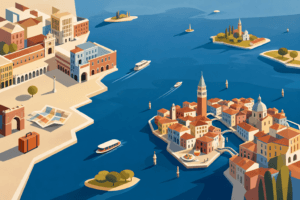
Before You Begin: The Most Useful Rule for Seeing Venice in Two Days
Distances in Venice can be misleading on a map. A route that looks short may take longer because you stop on a bridge, enter a church, turn into the wrong calle or simply decide that an unexpected detour deserves a few more minutes.
For this reason, a two-day visit is best organised around coherent areas, rather than repeated journeys from one end of the city to the other. The first day can be dedicated to Venice’s landmark buildings and most recognisable views; the second can leave room for more lived-in districts and a less predictable walk.
It is also useful not to fill both days with scheduled indoor visits. St Mark’s Basilica, the Doge’s Palace, a museum or an important church can be far more enjoyable when there is time around them to walk, have something to eat and look at the city without the next appointment already pressing.
Before your trip, it is worth checking three practical matters: whether the Venice Access Fee applies on the date of your visit, the availability of admission slots for St Mark’s Basilica and the Doge’s Palace, and which public transport tickets best suit your plans. These details can change, so they should always be checked through official channels before travelling.
Day One: Venice’s Monumental Side, from Morning to Evening Light
The first day is about meeting the Venice most people have imagined before arriving: St Mark’s Square, the Doge’s Palace, the Grand Canal and Rialto. These places can be busy, but avoiding them simply to create an “alternative” itinerary would make little sense on a first visit. What matters is how you experience them: with enough time, and with a few carefully chosen deviations along the way.
Begin in St Mark’s Square While the Day Is Still Young
When possible, St Mark’s Square is best seen early in the day. Not because every visitor must begin with the city’s most famous place, but because the square is easier to understand before it becomes crowded: the Basilica, the Campanile, the Procuratie and the sudden opening towards the waters of the Bacino di San Marco.
The square is not simply somewhere to take photographs. It is an urban composition designed to surprise: enclosed by regular buildings on several sides, then suddenly released towards the water, where the eye meets San Giorgio Maggiore across the basin.
This is the moment to decide calmly what you would like to visit inside. St Mark’s Basilica, with its mosaics and golden light changing according to the hour, offers an experience unlike that of any other church in the city. The Doge’s Palace, on the other hand, takes you into the Venice of government and ceremony, through institutional rooms and passages leading towards the prisons and the Bridge of Sighs, not merely as a photographic landmark but as part of a historical route.
Visiting both during the same morning is possible only with careful planning and well-managed reservations. For a more relaxed itinerary, it may be preferable to choose the one that best suits your interests and leave enough time for the square, the waterfront and the surrounding calli.
From the Riva degli Schiavoni into the Interior Calli
After St Mark’s Square, many visitors naturally continue along the Riva degli Schiavoni, attracted by the open view over the water, the moored gondolas and the outline of San Giorgio Maggiore in the distance. It is an obvious walk to take, especially on a bright day.
However, it is worth resisting the temptation to remain only along the city’s most visible edge. After enjoying the broad view from the waterfront, gradually turn back into the internal calli towards Castello, or find a quieter route returning in the direction of San Marco. Within only a few turns, one of Venice’s most recognisable settings can give way to low windows, hanging laundry, small bridges and doorways opening onto the water.
This is a useful moment to notice a typically Venetian difference: the most rewarding route is not always the most direct one.
Walking Towards Rialto, Following the City Rather Than Only the Signs
Between St Mark’s Square and Rialto, there is an almost continuous flow of visitors, guided by painted wall signs and arrows repeatedly pointing towards the bridge. The route is easy to follow, but often busy.
Without losing your bearings, allow yourself at least one small diversion: a campo appearing at the end of a calle, a quiet canal-side stretch, a church found without planning it. You do not need to get genuinely lost. Stepping away from the main path for just a few minutes is enough to understand how much more layered Venice is than its central visitor route.
The Rialto Bridge deserves its place in the day. It is one of the best points from which to perceive the Grand Canal as an actual waterway: vaporetti, service boats, buildings facing the canal and people crossing above the water all come together in a single, lively scene.
Descending towards San Polo, the character of the area shifts. The presence of the Rialto Market is a reminder that this part of Venice was not created merely to provide panoramic views, but as the city’s commercial heart. Even when the stalls are not at their busiest, the relationship between the market, the quays and the Grand Canal remains one of the clearest ways to understand Venice’s long connection with trade, goods and arrivals by water.
Take a Break Without Searching for the Perfect Lunch
After a morning between St Mark’s Square and Rialto, your break should serve one simple purpose: to sit down or pause somewhere, eat something and regain your energy. Venice is not best experienced by trying to optimise every minute.
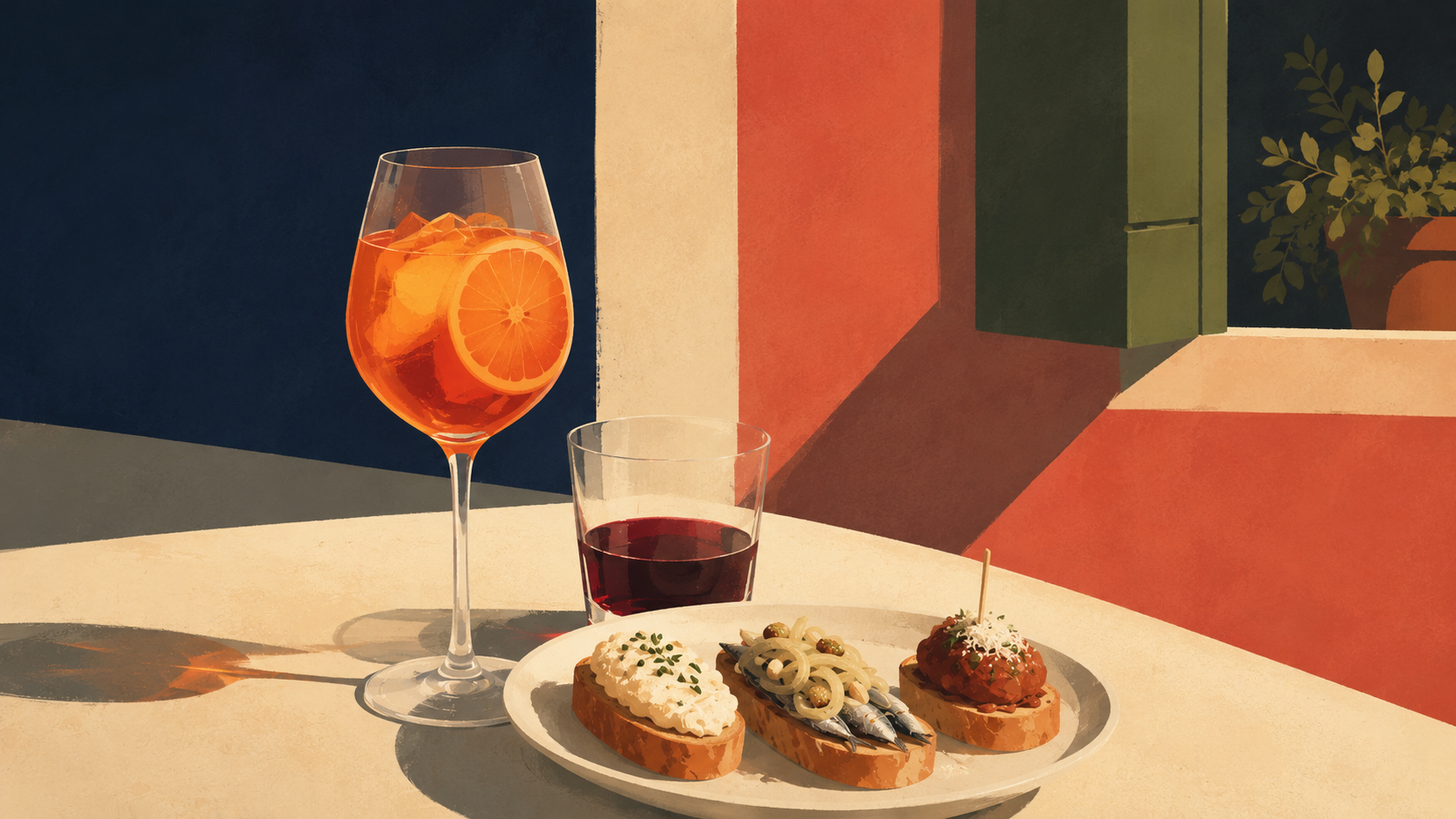
The San Polo area and the calli branching away from Rialto are good places to encounter bacari, the small Venetian bars where you can try a few cicchetti: small savoury bites often enjoyed with an ombra, a glass of wine.
Rather than turning your break into a hunt for the most famous venue, treat it as part of the day itself: a counter, a few choices made by looking at what is available, and some time spent observing the movement around you.
One practical piece of advice: when a particular place is completely packed and the surrounding area feels crowded, continue for a few more calli. In Venice, a more enjoyable pause is often waiting just beyond the place where everyone else stopped.
Spend the Afternoon in Dorsoduro and Let the Pace Change
After Rialto and San Polo, the afternoon can continue towards Dorsoduro, a sestiere that allows the first day to end in a different mood. Along the way, you may pass close to the Basilica dei Frari, cross broader campi and gradually reach the area around the Zattere or the Accademia.
Dorsoduro works particularly well after the density of the morning because it alternates important cultural places with stretches that are simply pleasant to walk through. The Accademia Bridge offers one of the city’s most familiar views over the Grand Canal, with the perspective leading towards the Basilica della Salute. The Zattere, facing the Giudecca Canal, offer a more open atmosphere, where Venice seems to stretch out and breathe.
There is no need to add a museum automatically at the end of the day, especially after visiting the Basilica or the Doge’s Palace in the morning. Reaching the Zattere, watching the boats pass and allowing the light to soften can be a far more balanced ending than forcing in one final rushed visit.
Day Two: Cannaregio, the Ghetto and a More Lived-In Venice
The second day should begin in a district that reveals a less ceremonial side of the city. Cannaregio is particularly well suited to this: close to Venice’s main entry points, crossed by lively routes, but also rich in long canal-side walks and corners where daily life is still easier to perceive.
Cannaregio in the Morning: Walk Along the Water Without Rushing Towards a Monument
A rewarding walk can begin near the Ponte delle Guglie and continue towards the Venetian Ghetto. Along the way, the water accompanies you without behaving like a stage set: there are moored boats, doorways, neighbourhood bridges and people moving through the area at the pace of an ordinary morning.
The Venetian word fondamenta describes a walkway running alongside a canal. It is a simple term, but it helps you read the city more clearly: walking along a fondamenta means having buildings, shops or house entrances on one side, and the canal on the other, with all the practical ways in which water remains part of Venetian life.
There is no reason to hurry through this part of the day. After a first day filled with major sights, it can be particularly satisfying to begin without immediately entering another monument, allowing the scale of the neighbourhood and the details of its waterside streets to guide you.
The Venetian Ghetto: A Place to Approach with Attention
The Venetian Ghetto is not simply an atmospheric stop to include on an itinerary. It is a place of major historical importance: its name entered several European languages, and its history deserves a more attentive approach than a quick photographic pause.
Arriving in Campo del Ghetto Novo, you immediately sense a space unlike many other Venetian campi. The unusually tall façades also speak of the historical need to live within a restricted area; the synagogues, incorporated into the buildings, refer to the presence and history of Venice’s Jewish community.
This is a place where it makes sense to lower your pace: read, observe and avoid passing through merely in search of an image. Any museum visits or guided tours should be checked in advance according to what is actually available during the period of your trip.
Fondamenta della Misericordia and Ormesini: Venice Without a Stage
From the Ghetto, it is natural to continue towards the Fondamenta degli Ormesini and the Fondamenta della Misericordia. Here Cannaregio reveals one of its most enjoyable sides: long canal banks, local venues, outdoor tables, bridges connecting the two sides and a form of urban life less dominated by monumental sightseeing.
It is an ideal area for a break, but also simply for walking. The contrast with the previous day is clear: there is no grand square to reach or absolute symbol to photograph. Instead, there are sequences of views, windows, boats, waterside paths and people sitting outdoors.
This is also an important way of getting to know Venice: understanding that the city is not lived only in ceremonial spaces, but in places where people buy something, drink a coffee, meet a friend or cross a fondamenta as part of their daily routine.
After Lunch: Choose Between One Final Venetian View and a Lagoon Detour
At this stage of your second day, it is better to make a choice rather than attempt to add everything.
Those who want to remain within Venice’s historic centre can cross the city again by choosing a different route from the previous day: walking through internal campi and calli, visiting a museum that genuinely interests them, returning to the Grand Canal at a different hour or continuing towards Castello and the area around the Arsenale, where Venice takes on a more austere and less commercial character.
Those who would prefer to see the lagoon from another perspective can dedicate part of the afternoon to a single island, rather than attempting to visit Murano, Burano and Torcello in only a few hours. During a two-day stay, an island detour makes sense only when it is a genuine personal priority: Murano for visitors interested in the glassmaking tradition, Burano for those seeking a markedly different urban landscape, Torcello for those wanting a quieter encounter with the lagoon.
For a first trip, however, remaining within the sestieri can be the more satisfying choice. Venice does not always need to be extended by adding extra destinations. Often, the final unplanned walks are the ones that leave the most personal memory.
What Not to Try to Do in Two Days
The desire to use every available hour is understandable, but Venice does not reward overloaded itineraries. Attempting to fit St Mark’s Square, the Doge’s Palace, the Basilica, Rialto, three museums, all the major islands, a gondola ride and several pre-booked restaurants into the same weekend usually means losing the pleasure of the city between reservations and transfers.
Over two days, it is worth consciously leaving something out. This is not a loss: it is what allows the visit to retain its rhythm and meaning.
It is better to choose:
- one museum visited attentively rather than three crossed in a hurry;
- a single lagoon destination, when it truly matters to you, rather than an exhausting race through several islands;
- a pause in a bacaro discovered along your route rather than running between one reservation and the next;
- a stretch walked slowly through calli and over bridges rather than treating every transfer as wasted time.
A successful first visit is not one in which you manage to see every famous place. It is one in which, as you leave, you feel that you have encountered a real city rather than simply a collection of its most familiar images.
Practical Details to Check Before Travelling
A two-day itinerary becomes much easier when a few decisions are made in advance.
When you wish to visit St Mark’s Basilica or the Doge’s Palace, check availability, tickets and admission times on the official websites before you travel. During busier periods, relying only on last-minute decisions can end up shaping the entire day.
It is also worth considering how much you will use public transport. Visitors planning several vaporetto journeys or a detour to one of the islands may find it useful to compare the transport tickets available through the official Venezia Unica portal. Those spending both days mainly walking through the historic centre may have different needs.
Finally, when your trip falls on one of the dates covered by the Venice Access Fee, check the official portal for the rules applying to your particular visit and complete any required steps in advance.
Visiting Venice in Two Days While Staying in Mestre
For a short stay, choosing a base in Mestre city centre can make sense for visitors who want to devote their days to Venice while spending the night in a different urban setting from the historic lagoon centre.
This option fits particularly well with a two-day itinerary: you begin each day with a clear plan, spend your time among calli, campi, museums and fondamenta, and organise your stay without needing to concentrate every part of the experience within Venice’s sestieri.
For couples or small groups, a short-stay apartment in Mestre city centre can accompany this kind of trip in a simple and practical way: primarily intended for two people, with space for up to four guests, it can be considered as a base for visiting Venice and, perhaps, discovering a few corners of Mestre as well.
Two Days Are Enough to Begin Knowing Venice
On the first day, Venice presents itself through the places that have made it recognisable throughout the world: the square opening towards the water, the mosaics of St Mark’s, the Doge’s Palace, Rialto and the Grand Canal.
On the second day, when enough space is left in the itinerary, the city begins to shift in tone: a fondamenta in Cannaregio, the thoughtful atmosphere of the Ghetto, a pause made without an appointment, a calle entered simply because it looked inviting.
Two days are not enough to exhaust Venice, and perhaps that is precisely their value. They are enough to see a great deal, to begin finding your bearings, to recognise a campo as something more than an ordinary square and a fondamenta as something more than a canal-side walkway. Above all, they are enough to understand which Venice you would like to return to next time.
Related Posts
First time in Venice: the complete planning guide
Planning your first trip to Venice? This guide helps you choose your stay, decide how many days to allocate, pick key visits, and understand transport,…Three days in Venice: a slow itinerary through the historic center, islands and Mestre
A slow three-day itinerary among sestieri, the lagoon and Mestre center, with stops, bacari and everyday details.
Staying in Mestre to Visit Venice: When the Mainland Makes Your Trip Easier
Choosing Mestre as your base gives you a straightforward mainland experience with easy access to Venice by day, offering urban normality after the intense rhythms…Questions Answered
How should I plan my two-day visit to Venice for the best experience?
Focus day one on main landmarks, day two on local neighborhoods without rushing.What practical checks are important before traveling to Venice?
Check access fees, ticket availability, and public transport options in advance.What should I avoid trying to do during a short stay in Venice?
Avoid cramming too many museums or island visits to prevent exhaustion.Is it worthwhile to stay in Mestre while visiting Venice?
Staying in Mestre can be practical, allowing day trips into Venice without overnight limitations.
Plan a first visit without rushing
Have two days and want to connect the itinerary with transport, food and a few deeper stops?
 Staying in Mestre to visit VeniceVisiting Venice does not necessarily mean sleeping inside the lagoon. For many travellers, especially on a short stay, it can make more...
 Bacari and Cicchetti: Understanding Venice Through Its Simplest RitualIn Venice, some experiences do not need to be overplanned. You enter a small place, look at the counter, choose a couple...
 Venice Beyond St Mark’s Square: 12 Details to Notice While Walking SlowlyIn Venice, it is natural to look up at a bell tower, stop in front of a palazzo or search for the...