
The monument to Bartolomeo Colleoni is one of those places where Venice corrects expectations. It is not in Piazza San Marco, as the condottiere would have wanted in his bequest, but in the campo of Santi Giovanni e Paolo, in Castello: a more everyday space, crossed by residents, students, attentive visitors. Here Verrocchio’s horse is not only a celebratory equestrian statue. It is a tense balance between military power, Venetian diplomacy and urban form, with a protagonist who seems to advance into the square without ever fully giving himself over to spectacle.
Where it really is: not San Marco, but Castello
The equestrian monument to Bartolomeo Colleoni is not in Piazza San Marco, nor in its immediate surroundings. Its location is in the sestiere of Castello, in the campo of Santi Giovanni e Paolo, one of the most important monumental spaces of inner Venice. This fact is not secondary: it shifts attention from the ceremonial Venice of dogal power to the city of confraternities, hospitals, Dominican churches and great families.
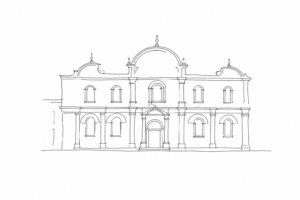
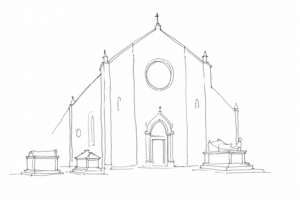
The statue dominates the campo in front of the façade of the basilica of Santi Giovanni e Paolo, often called in Venetian San Zanipolo, and beside the Scuola Grande di San Marco. The condottiere, who had left the Republic a substantial bequest requesting a monument “in Piazza San Marco,” obtained a skillfully Venetian solution: not the political heart of the city, but the campo by the Scuola di San Marco. Thus Verrocchio’s horse presides over a solemn place, but outside the official Marcian stage.
Colleoni and the pact with Venice
Bartolomeo Colleoni was not a Venetian ruler, but a condottiere: a professional soldier in the service of the Italian states of the fifteenth century. Born in the Bergamo area, he linked the most important part of his career to the Serenissima, becoming captain general of its armies and a decisive figure in the mainland campaigns.
The monument was born from a political gesture as well as a commemorative one. On his death, in 1475, Colleoni left Venice a large sum, asking in return that his memory be fixed in an equestrian monument in the city’s most representative square. The request was delicate: an individual, armed and triumphal statue would have introduced into the Venetian civic heart an image of personal power scarcely compatible with republican ideology.
The solution was a subtle compromise. Venice accepted the inheritance and the public honor, but moved the horse in front of the Scuola Grande bearing the evangelist’s name, in the campo of Santi Giovanni e Paolo. Thus Colleoni obtained monumental visibility, while the Republic maintained symbolic control of the urban space.
Verrocchio’s horse: strength, control, movement
The equestrian statue created by Andrea del Verrocchio does not merely celebrate a victorious commander: it constructs an image of restrained energy. The horse advances with one leg raised, but the step does not become a run; the tension remains compressed in the bronze, as if the animal were ready to spring and at the same time perfectly mastered.
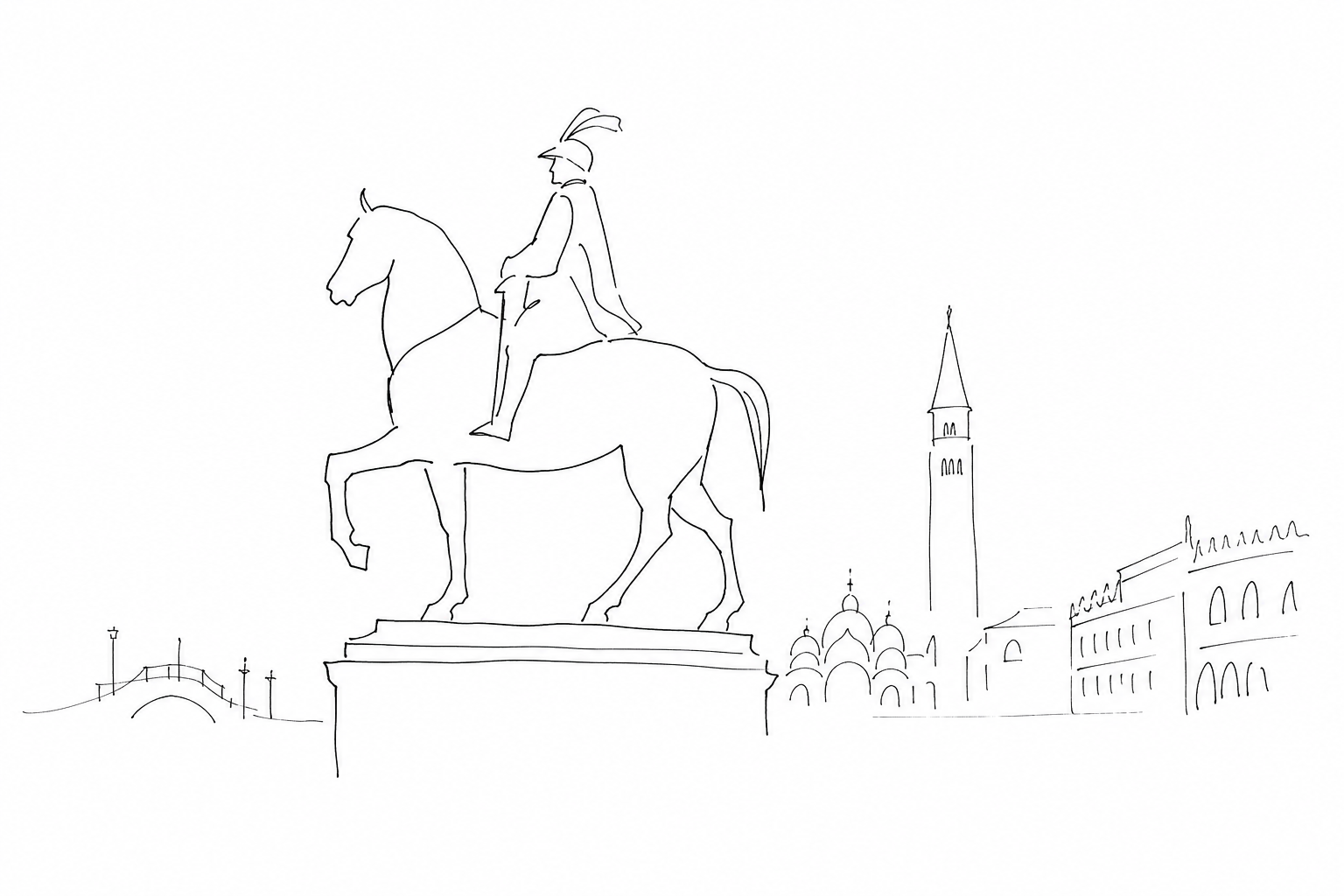
It is here that the work shows its full Renaissance culture. Verrocchio looks to ancient models, in particular to the tradition of the imperial equestrian statue, but avoids the static pose. The condottiere is firm in the saddle, with his torso upright and his gaze direct; the armor, the baton of command and the position of the body transform the figure into an image of military authority.
The relationship between rider and animal is decisive. There is no separation between portrait and war machine: the body of the horse, powerful and nervous, becomes an extension of its master’s will. The bronze casting, completed after Verrocchio’s death by Alessandro Leopardi, preserves this idea of difficult balance: movement, weight and discipline coexist.
Observed from the campo of Santi Giovanni e Paolo, the statue does not demand a single frontal view. It changes with the viewpoint: the profile emphasizes the advance, the diagonal accentuates the command, close passage reveals muscles, trappings and details of the armor.
Why being outside Piazza San Marco still matters
The location in Campo Santi Giovanni e Paolo is not a neutral fallback: it is part of the meaning of the work. Bartolomeo Colleoni had left a bequest to the Serenissima requesting a statue in the square named after San Marco; the Venetian government, reluctant to grant the political heart of the city to a personal image of military power, chose a highly skillful solution. The figure was placed in front of the Scuola Grande di San Marco, not in the ducal space.
For those who visit today, this detail changes the reading. Beside the Dominican basilica, a place linked to the burials of the doges, and the façade of the Scuola, the commander appears close to the institutions, but not above them. Venice honors him, but keeps him at a distance from the ceremonial center. Looking at the bronze group from this campo therefore also means seeing a political compromise: glory granted, but controlled.
Looking at the Colleoni outside San Marco means understanding something about the way Venice manages memory, prestige and public space. The Republic respected the pact, but interpreted it in its own way; Verrocchio transformed a political monument into a physical presence of extraordinary precision. In the campo of Santi Giovanni e Paolo, far from the city’s most obvious stage, the condottiere remains visible without dominating everything: he dialogues with the church, the scuola, the everyday passage. And it is precisely this decentralized position that makes him even more interesting.