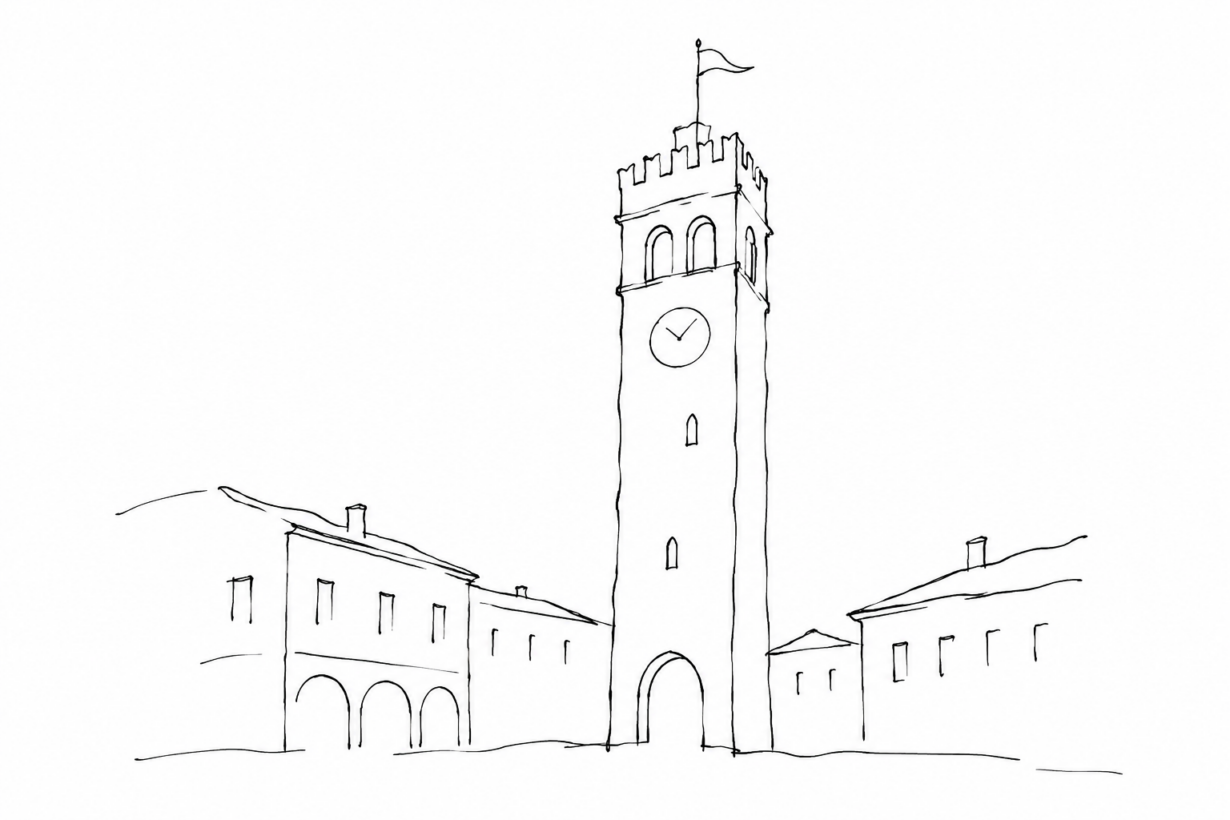

In Mestre, all you need to do is look up at the Civic Tower to realize that the center did not develop only around shops, buses and connections with Venice. That tower, often passed through almost without thinking, is the clearest fragment of a walled city that had gates, duties, walls and a close relationship with the Venetian mainland. This article helps you read it better: what truly belongs to the medieval castle, what has been transformed over the centuries and how to organize a visit without expecting a large museum, but rather a small and very instructive place.
The Civic Tower today: the most visible remnant of the castle
To understand medieval Mestre, the simplest starting point is the Civic Tower. It rises between Piazza Ferretto and via Palazzo, right where the pedestrian center changes pace: on one side the square with its porticoes and everyday strolling, on the other the axis that recalls the ancient entrance to the walled city.
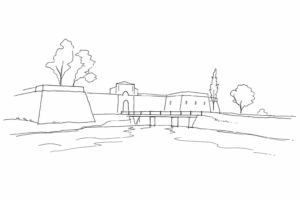
What many people today call the Clock Tower was not created as an isolated monument. It was the Borgo Gate, also called the Loza Gate, one of the gates of Mestre’s Castelnuovo. The reason it still stands out is simple: it is the only one of the three ancient gates that remains readable in its entirety, while the rest of the defensive system has disappeared, been incorporated or is recognizable only through traces and reconstructions.
Looking at it this way helps change your perspective on Mestre. It is not just a base for reaching Venice: it had its own fortified center, controlled entrances, civic spaces and an independent urban history. The tower is the most immediate sign of this continuity.
From the bishops’ castle to Mestre’s Castelnuovo
Before the Civic Tower we see today, Mestre had already experienced a fortified phase. The first castle dates back to the 11th century and was built by the bishops of Treviso in an area different from the present square: the area of the former Umberto I hospital. This detail is useful because it avoids a frequent misunderstanding. The tower does not mark the exact spot of the original fortified nucleus, but the place where the walled city took shape in the following phase, under Venice.
The decisive turning point came after September 29, 1337, when Mestre entered the Venetian sphere. For the Serenissima it was not just any possession: controlling Mestre meant guarding the mainland opposite the lagoon, monitoring roads, traffic, goods and access routes to Venice. Hence the decision to build a new fortress, larger and suited to a center that was not only military, but also commercial and administrative.
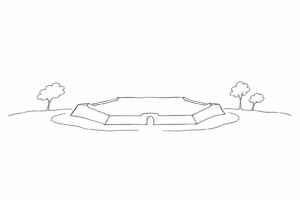
This second layout is Castelnuovo. Its shape is described as a shield-shaped plan, with a perimeter of more than a kilometer: dimensions that help you imagine a medieval Mestre very different from today’s open, pedestrian center. Not a simple enclosure around a few houses, then, but a defended urban organism, with gates, stretches of wall, internal spaces and control functions.
The Civic Tower belongs precisely to this Venetian period. To read it correctly, it is therefore useful to think of two castles layered in the city’s memory: the first, episcopal and Trevisan, in the area of the former Umberto I; the second, Venetian, extending around the current heart of Mestre. The tower is what still allows you to visually connect with that transformation.
Gates, walls and clock: reading what remains
To understand what truly remains of the defensive system, it is worth separating three levels: the medieval structure, the modern transformations and the 19th-century interventions. The Civic Tower corresponds to the ancient Borgo Gate, also called the Loza Gate, and is the only entrance preserved in complete form. The other two entrances to the enclosure, Altino Gate or Molini Gate to the east and Belfredo Gate to the west, did not have the same fate.
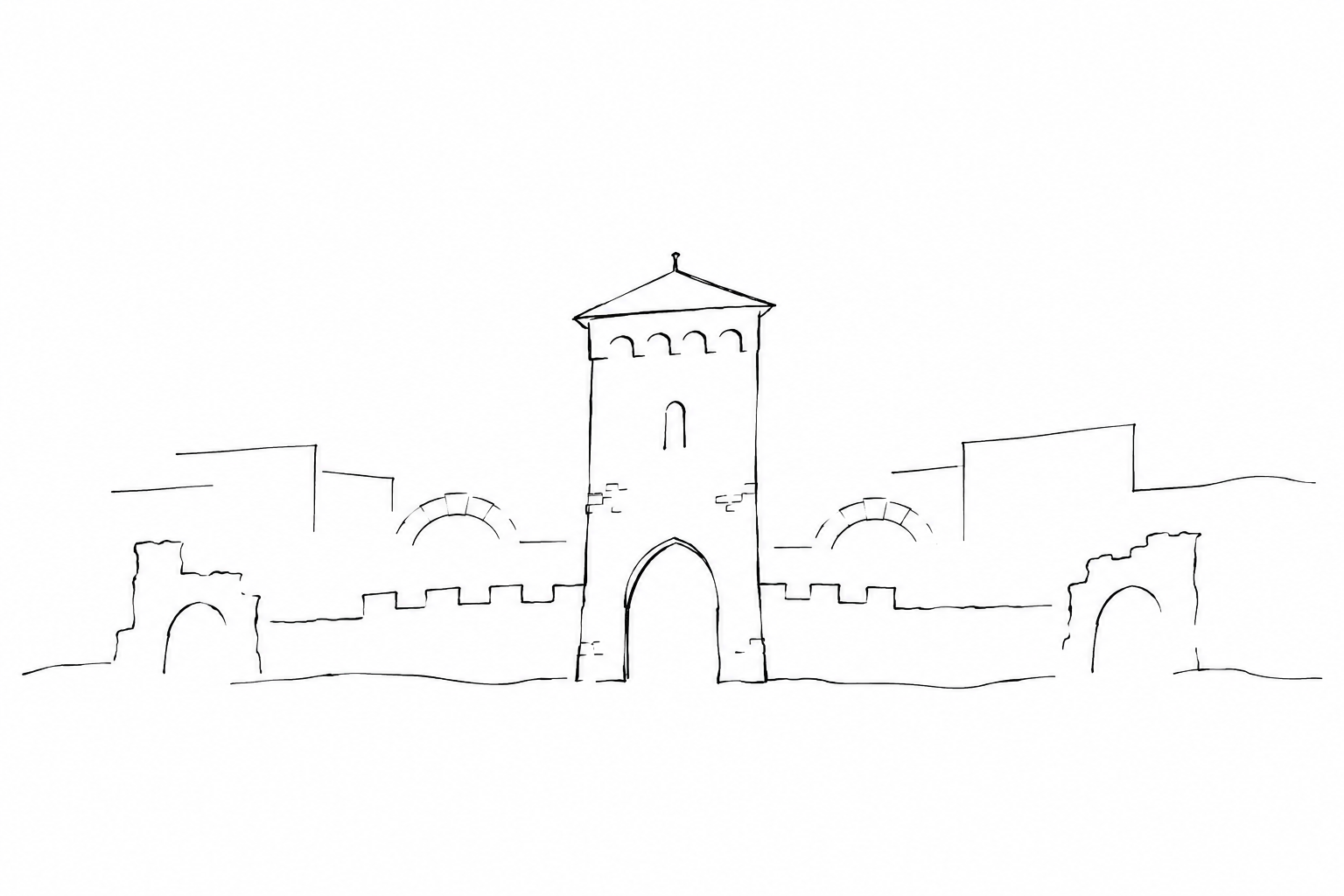
Those three openings were not only military passages: they were also customs gates. Anyone entering with goods, animals or products intended for the market found here the fortified city’s fiscal control point. It is an important detail, because it explains why the castle was not only a defensive machine: it regulated traffic, tolls and access to Venetian Mestre.
As for the walls, however, you should not expect a continuous curtain wall. The Castelnuovo enclosure, with its shield-shaped plan and perimeter of more than a kilometer, was gradually erased; in the 18th century the walls were demolished and in the 19th century the Belfredo Tower, its western twin, also disappeared. The Clock Tower remained as an isolated sign, later adapted to the new urban layout.
Even what seems medieval must be read carefully. The battlements on the roof belong to the 19th-century works, not to the original phase. Between 1826 and 1828, after a municipal ordinance of 1824, major renovations were carried out and three passages were opened on the ground floor, forming the portico that is still crossed today. The clock, instead, is documented as a public clock as early as 1573: a civic element, not only decorative, that transformed the gate into a daily point of reference for the community.
How to visit the Civic Tower: address, opening hours and rooms
The visit is easy to organize: the Civic Tower is located at via Palazzo 55, in Mestre, on the passage between Piazza Ferretto and via Palazzo. The municipal opening hours indicate opening Tuesday to Saturday 10–12:30 and 17–19:30, Sunday 10–12:30; it is closed on Monday.
The ground floor is the part accessible to everyone and is also where it is best to begin. Here you will find the model of ancient Mestre, archaeological finds from the De Gelthof Fund, a head of Mercury in a niche, the bronze bell of the old clock, the pendulum of the clock mechanism and panels that reconstruct the urban history.
The upper levels are reached by an external staircase; accessibility is guaranteed only on the ground floor and there are no toilets in the building. On the top floor the display changes tone: a large satellite image and photographic projections help connect the tower to the contemporary city.
As for timing, consider it a short but dense visit: about half an hour is a realistic amount of time if you want to read the main panels and observe the objects without rushing.
The Civic Tower does not require a long detour, but it changes the way you look at Mestre. After recognizing its function as a gate, the public clock, the traces of the defensive system and the later interventions, the center appears less “modern” than it seems at first glance. It is a short visit, also suitable for those with little time, but useful for giving depth to a walk between Piazza Ferretto and the nearby streets. Before going, it is only worth checking the updated opening hours on the municipal channels: the rest is done by the tower, with its discreet and very concrete presence.