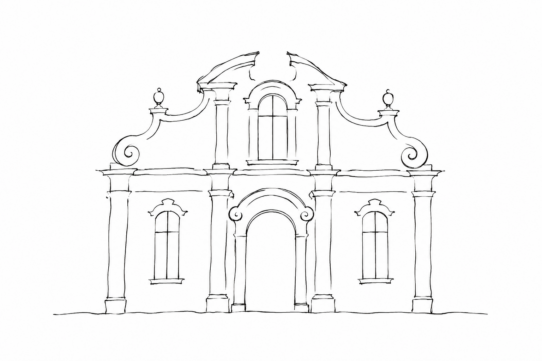
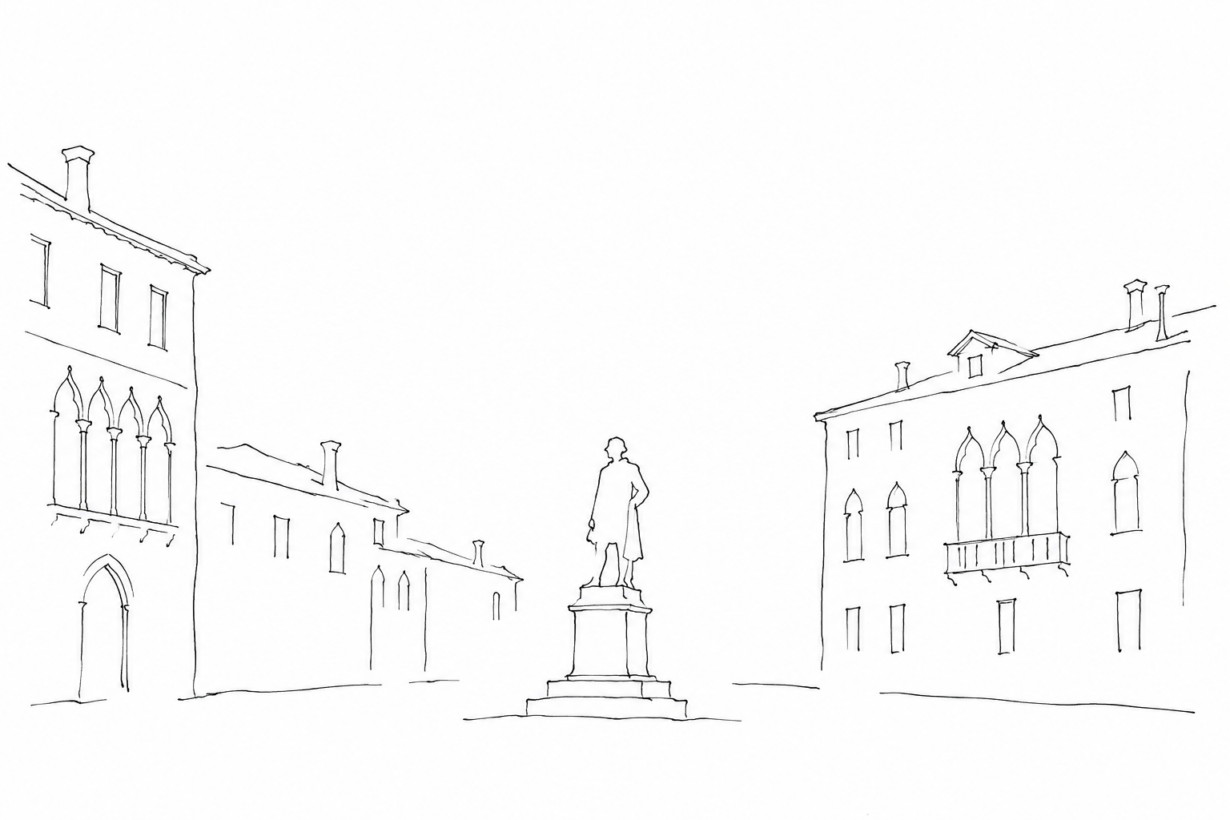

Campo Manin is one of those Venetian places that many people cross without really looking at. It does not have the scenic balance of other campi, nor the secluded quiet that is often sought far from the most beaten paths. And yet, precisely in this somewhat angular square, central but rarely celebrated, important passages of the city can be read: a vanished church, a Risorgimento memory, debated architecture and a daily flow that almost never stops. It is worth slowing down: not to find the most beautiful Venice, but a very instructive Venice.
A central square, but often crossed in a hurry
Campo Manin is in a position that, on paper, should make it one of the most observed points in the sestiere of San Marco: it lies along the route between Rialto and San Marco, within that network of calli where visitors’ pace quickens almost without them noticing. And indeed many use it in this way, as a junction: they enter, orient their gaze toward the next calle, and set off again.
Its reputation does not help. Compared with other Venetian campi it appears harsher, less intimate, marked by twentieth-century volumes and by a spatiality that does not immediately invite one to stop. But this very sensation is the reason why it is worth pausing for a few minutes. Campo Manin tells of a Venice that has been modified, cut, reorganized; not only the city of Gothic façades and “textbook” campi.
Here the relationship, often rough, between civic memory and urban transformation can be clearly read: the name of Daniele Manin, the Venetian Risorgimento, the ancient layout of the place and the daily use of a central square that continues to be crossed more than inhabited. Looking at it calmly means understanding a less comfortable, but very concrete, part of the city.
Before Manin: the ancient Campo San Paternian
Before bearing the name of Daniele Manin, this space was Campo San Paternian. The change of name is not a detail for a plaque: it signals a fracture in the memory of the place. Where today one perceives a square with an irregular and modern layout, the church of San Paterniano once stood, around which the ancient campo was organized.
Tradition traces the origin of the church back to the final decades of the 9th century, linking it to the Andrearda family and to the cult of San Paterniano, bishop of Fano. As often happens in Venice, the account of the origins mixes devotion, founding families and topography: the saint’s name did not indicate only a religious building, but a small urban system made up of parish, houses, passages and everyday references.
The church no longer exists, but it has not completely disappeared from the city. Some elements from the demolished San Paternian are preserved in the small garden of Palazzo Pisani-Revedin: arches and wellheads, including an 11th-century Veneto-Byzantine wellhead. It is a useful detail for reading the campo without stopping at the first impression. The absence of the church has left a physical void; the saved fragments, moved just a few steps away, instead tell how stratified this point of the sestiere of San Marco was before the Risorgimento dedication.
Daniele Manin: the name that changes the campo
The dedication to Daniele Manin is not a simple patriotic dedication placed upon an already existing space. In Campo Manin the monument functions as a key to interpretation: in public memory it replaces the ancient religious reference of San Paternian with a political figure linked to the moment when Venice tried to rethink itself within the Italy of the Risorgimento.
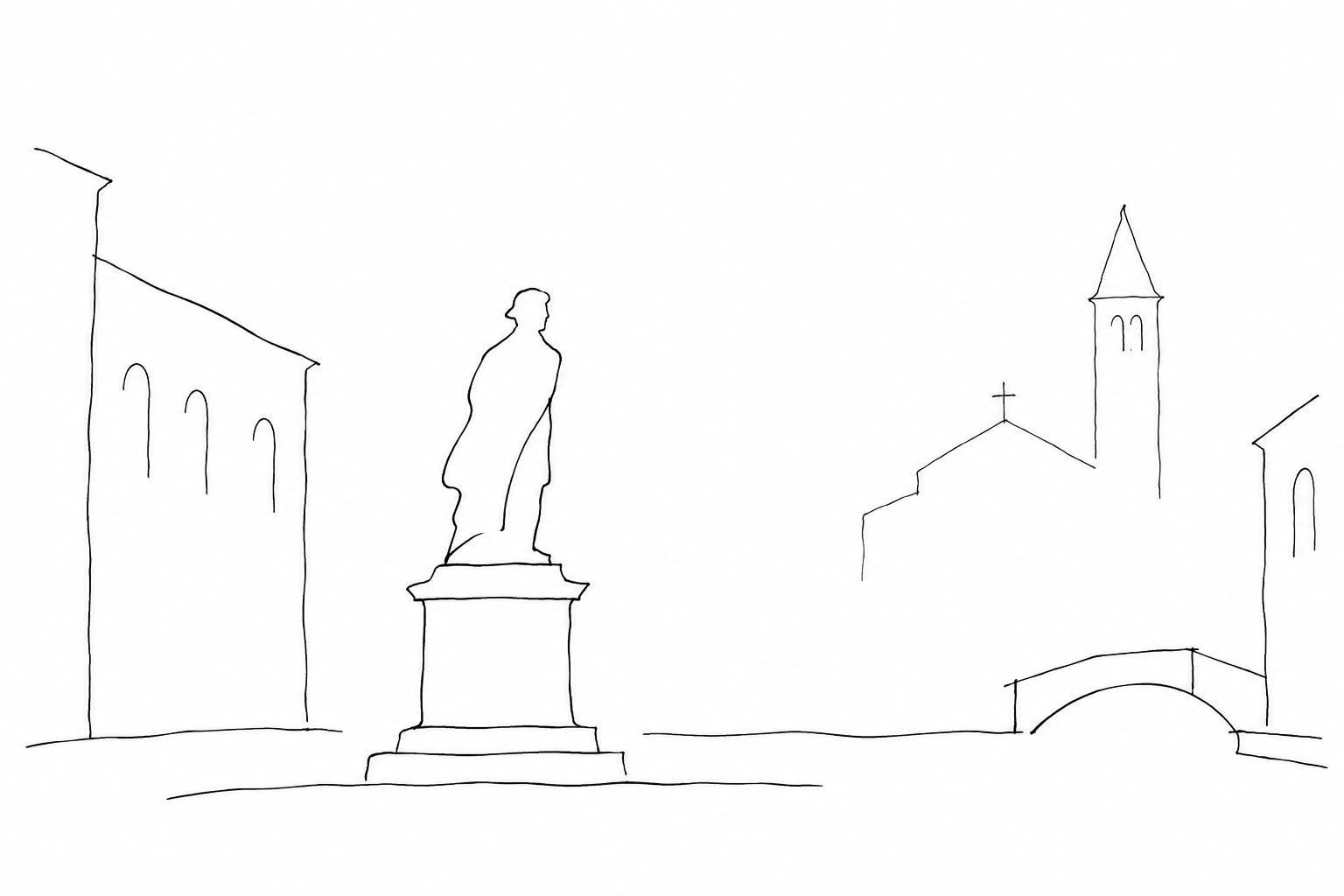
Manin was born in Venice on May 13, 1804. He was a lawyer, patriot and, above all, the face of the revolutionary season of 1848-1849, when he led the Venetian insurrections against Austrian rule. His story is linked to the rebirth of the Republic of San Marco, a brief but decisive experience for the city’s civic imagination: not a re-enactment of the Serenissima, but a nineteenth-century political project, within a very concrete European crisis.
Seen from the campo, this passage matters. The statue does not celebrate a distant figure in the abstract; it inserts into the route between Rialto and San Marco the memory of a Venice that, in the nineteenth century, discussed freedom, independence and the national future. Manin’s biography too does not remain fixed only on the republican line: in his final years he supported Italian unity according to Cavour’s monarchical program, contributing to the climate from which the National Society was born.
For this reason the campo, though little loved by many passers-by, has a precise political density. Its center is not decorative: it tells of the city’s change of language, from parish to civic memory.
What to look at today in Campo Manin
To get your bearings in Campo Manin it is best to start from the contrast that catches the eye: on one side the monument to the patriot, on the other the severe front of Palazzo Nervi-Scattolin. Designed by Pier Luigi Nervi with Angelo Scattolin and inaugurated in 1972, the building introduces into the campo a scale different from that of the surrounding houses. The compact surfaces, the regular design of the openings and the relationship with the central void clearly explain why this square divides opinions.
In the campo it is then worth looking for Palazzo Pisani-Revedin, today also linked to the Officina Aldina gallery and boutique. It is a useful reference because it brings the gaze back to a Venice of private palaces, courtyards, internal gardens and reused fragments: a fabric less evident than the large twentieth-century volume, but decisive for understanding the complexity of the place.
The visit does not require a long stop. A few minutes standing in the center are enough, letting the flow of those cutting through toward Rialto or toward San Marco pass by. Observed from there, the campo appears for what it is: not a harmonious square, but a point of friction between civic history, demolitions, modern architecture and daily routes.
Campo Manin does not ask to be loved at first glance, and perhaps this is precisely its strength. It forces one to read Venice also where the city does not coincide with the easiest image: in the erasures, in the changed names, in the debated buildings, in the political memories placed at the center of public space. Stopping here for a few minutes, instead of merely crossing it, helps one better understand the sestiere of San Marco and the way Venice continues to overlay different eras without always making them conciliatory.