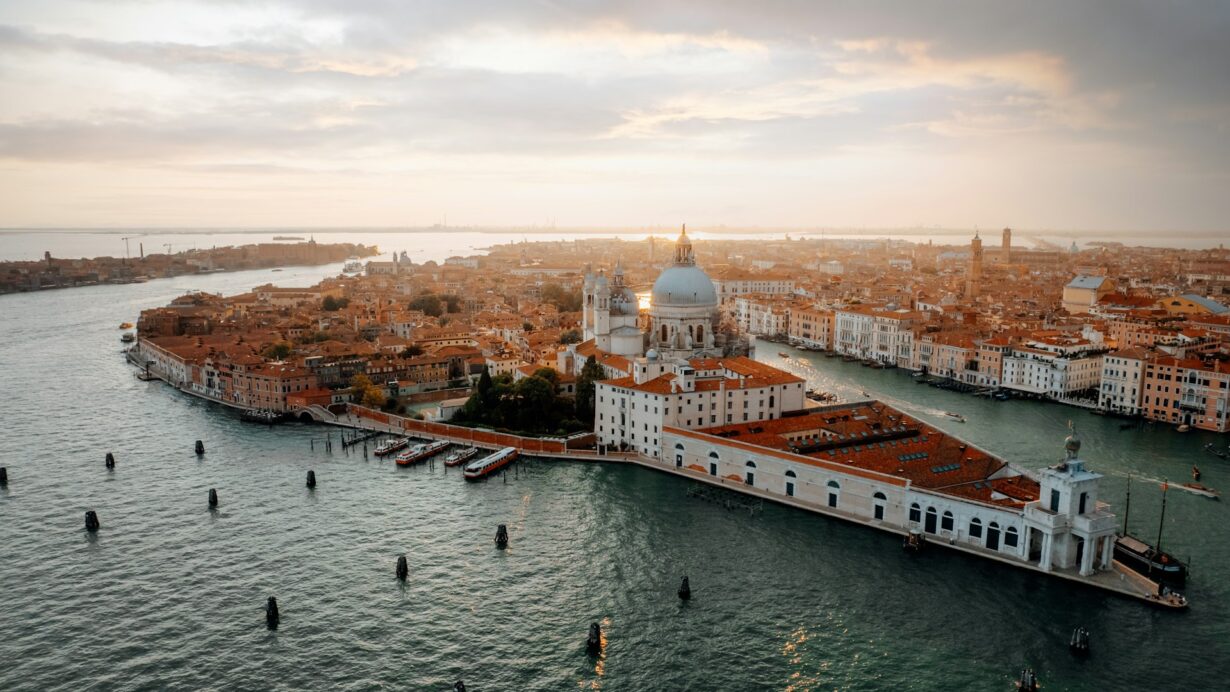

For your first time in Venice, two full days allow you to see the main landmarks and explore at least one neighbourhood beyond San Marco; three give you more room for museums, breaks or a lagoon trip. Most exploring happens on foot, with waterbuses for journeys that need them. Start by choosing where to stay: it shapes your arrival, evenings and overall spending.
This guide helps you make those decisions before building an itinerary. It explains stations and terminals, which tickets to compare and what is worth booking. Walking and visiting times are planning estimates, not routes timed on the ground; budgets are worked examples, not market averages.
Practical information last checked: 14 September 2026. Official sources are linked alongside the relevant details. For later trips, check fares, availability and service notices again.

In this guide
- First time in Venice: five decisions to make
- How many days do you need in Venice?
- Where to stay: historic Venice, Mestre or elsewhere?
- Getting to Venice: stations, airports and terminals
- Getting around: walking, waterbuses, ferries and gondolas
- What to see on a first visit
- What to book ahead and what to leave open
- What Venice costs: three worked budgets
- Mistakes to avoid and the Venice access fee
- Before-you-go checklist
First time in Venice: five decisions to make
Venice becomes easier to navigate once you stop treating it as a city where a taxi can collect you from any front door. In the historic centre, the final stretch matters: a bridge, steps or a landing stage on the opposite bank can change the journey with luggage.
- How much usable time do you have? Count the hours between arrival and departure: two nights do not necessarily mean two full days.
- Where do you want to spend your evenings? Staying in the historic centre, Mestre or the Lido means different journeys home.
- Where will you enter the city? Santa Lucia is the historic centre’s railway station; Venezia Mestre is on the mainland; Piazzale Roma is the road terminal.
- Which two visits matter most? Build your bookings around those and keep the rest flexible.
- How much transport will you use? Choose a waterbus pass after sketching your days, rather than automatically buying one with your accommodation.
With one day, focus on San Marco, Rialto and a coherent walk through the city. With three days, decide whether to spend the third on the islands or exploring Venice further: trying to do both can turn it into a day of transfers.
How many days do you need in Venice?
For a first visit, our recommendation is two or three full days. That is a planning judgement, not a rule: the right length depends on how many interiors you want to visit and how much walking suits you.
| Time available | What to plan | What to leave for another trip |
|---|---|---|
| One full day | San Marco, Rialto and one continuous neighbourhood walk; at most one lengthy visit | A full island circuit and several major museums |
| Two full days | Main landmarks, one or two selected interiors, Cannaregio or Dorsoduro, and an evening in Venice | Murano, Burano and Torcello all together |
| Three full days | Monumental Venice, neighbourhoods and a day for either the lagoon or more museums | The ambition to see everything |
| Four days or more | More neighbourhoods, focused visits and islands with greater flexibility | A fixed appointment for every hour |
Arriving on Friday evening and leaving on Sunday morning gives you mainly Saturday. Before purchasing admission tickets, write down when you will reach your accommodation and when you must leave for the station or airport. Those times are more useful than the number of nights.
Once you have chosen your trip length, the three-day Venice itinerary with a base in Mestre helps you turn it into a route. This guide stays with the initial decisions rather than duplicating a day-by-day itinerary.
Where to stay: historic Venice, Mestre or elsewhere?
Accommodation determines how each day begins and ends. Compare the final accommodation bill, transfers, exact location and accessibility, rather than the nightly rate alone.
| Base | When it makes sense | What to check |
|---|---|---|
| Venice’s historic centre | You want early starts and late returns without a mainland transfer | Luggage route, bridges, floor, lift and actual distance from the landing stage |
| Central Mestre | You want an urban base with restaurants, shops and evenings around Piazza Ferretto | Useful stop, evening connections and the full journey to Venice’s terminal |
| Mestre station area | Rail connections are your priority | Exact address: the station and Piazza Ferretto are different areas |
| Lido | You want to combine Venice with time on the Lido island | Waterbus journey time and frequency, including the return |
| Giudecca | You want to stay on a separate island facing the city | Boat connections: there is no pedestrian bridge to Dorsoduro |
Within historic Venice, consider Santa Croce and the part of Cannaregio near the station for a rail arrival; San Marco for the monumental sights; Dorsoduro if art and waterfront walks are central to your plans. These are geographical pointers. Convenience depends on the individual address, not simply the district name.
Central Mestre offers places for dinner, aperitivo, shopping and walks around Piazza Ferretto. It can be a strategic choice even when finding the lowest price is not your main aim. Compare two actual properties for your dates, including transport costs and time: Mestre cannot be assumed to be cheaper in every case.
Read more about staying in Mestre to visit Venice. That page also introduces the small apartment at Viale Garibaldi 52/C in central Mestre, designed mainly for two guests and accommodating up to four. It is on the fourth floor, counting the street level as the ground floor, with no lift: factor in the stairs before considering it. Check the page for the current booking status.
Getting to Venice: stations, airports and terminals
Santa Lucia and Piazzale Roma are gateways to pedestrian Venice; neither is St Mark’s Square. Allow time to reach your accommodation or first attraction after getting off your train or bus.
By train
Choose Venezia Santa Lucia as your destination if you want to arrive directly in the historic centre. Venezia Mestre is useful for a mainland stay or a connection. Read the actual station printed on your ticket, even when a search screen simply says “Venice”.
Outside Santa Lucia are the Grand Canal and waterbus landing stages. Walk or take a waterbus according to your destination. The Mestre–Santa Lucia train journey is only part of the calculation when staying in central Mestre: add the journey to the station and waiting time.
By car or coach
Piazzale Roma and Tronchetto are the main parking options at the edge of historic Venice. From Tronchetto you still need to continue to your destination; parking in Mestre also requires a journey across the lagoon. For several nights, compare the full parking bill and check height restrictions and reservation arrangements on the parking operator’s website.
For long-distance coaches, read the exact stop name: “Venice” may refer to a different terminal from the one you expected. Do not use a hotel address in a historic-centre alley as your driving destination.
From Marco Polo Airport
The airport lists ACTV route 5 and ATVO Express for Piazzale Roma; ACTV route 15 and ATVO Express for Mestre station. Water transport options include Alilaguna and private water taxis. Choose according to your accommodation address and the final stretch with luggage. Official Marco Polo connections.
From Treviso Airport
ATVO connects Treviso Airport with Mestre and Venice; Barzi serves Mestre and Tronchetto. Check the Venice terminal before buying. Under the service arrangement introduced in August 2026, ATVO advertises 30 minutes to Mestre and 40 to Venice. These are the operator’s advertised journey times, not landing-to-accommodation times. Add baggage collection, waiting and the final leg. Treviso Airport transport options and current ATVO service.
If you are staying in Mestre, plan the journey to your accommodation first, then the journey into Venice. The Mestre to Venice transport guide explains the choices in more detail.
Getting around: walking, waterbuses, ferries and gondolas
Three local words help with orientation: a calle is a street, a campo a square, and a fondamenta a walkway beside the water. Waterfront paths do not always continue, and there will not necessarily be a bridge where you need one.
How much walking time to allow
For unhurried planning, allow roughly 35–45 minutes from Santa Lucia to Rialto, 15–25 from Rialto to San Marco, and 45–60 from Piazzale Roma to San Marco. These are indicative allowances for a first visit without lengthy stops; crowds, detours, luggage and personal mobility can increase them. They are not on-site measurements.
The vaporetto, or waterbus, is useful for islands, longer journeys and seeing the city from the water. For a short trip, waiting and intermediate stops may make it slower than walking. At the landing stage, check the destination, direction and platform letter as well as the route number.
A traghetto da parada is a gondola ferry that crosses the Grand Canal between specific points. It is not a sightseeing ride or a substitute for the waterbus; check operation and fare locally. A water taxi is a private transfer for which you should obtain a quote. A gondola ride is an optional experience, chosen for its route rather than everyday transport.
Single ticket or pass?
| Ticket | Checked price |
|---|---|
| ACTV standard network ticket, 75 minutes | €9.50 |
| ACTV urban bus/tram ticket, 75 minutes | €1.50 |
| Venezia Daily Pass, 24 hours | €25 |
| ACTV 48 hours | €35 |
| ACTV 72 hours | €45 |
| ACTV 7 days | €65 |
Source: ACTV fares. Marco Polo Airport services and Alilaguna are not included in the standard tickets compared here. The Daily Pass purchased as an integrated ticket includes specified urban regional trains; do not assume that multi-day passes or bank-card payments have the same rail validity.
Two €9.50 tickets cost €19; three cost €28.50. The €25 pass becomes cheaper when you would otherwise need a third ticket within the same 24 hours. Count tickets needed, not every connection made within a 75-minute period. An island day may justify a pass even if you walk on the other days.
Follow the validation instructions for the ticket format you choose: purchase does not always mean activation. The AVM app instructions explain buying and using digital tickets.
What to see on a first visit
Start with St Mark’s Square, the exterior of the Doge’s Palace, Rialto and the Grand Canal. Together they introduce the city’s monumental and commercial heart. Then add a neighbourhood you can explore as a continuous walk: Dorsoduro between Accademia and the Zattere, or Cannaregio towards the Jewish Ghetto and canalside streets.
Choose interiors according to your interests: St Mark’s Basilica for mosaics and sacred space; the Doge’s Palace for state rooms and Venetian political history; the Gallerie dell’Accademia for Venetian painting; the Peggy Guggenheim Collection for modern art. Booking all four is not a requirement for a worthwhile first trip.
As planning estimates, allow 45–60 minutes for an essential Basilica visit, 2–3 hours for the Doge’s Palace and 1.5–2.5 hours for a major museum. Add queues, checks and travel; more extensive Basilica tickets need more time.
If something must go, drop a second panoramic viewpoint, a gondola ride you are not particularly interested in, or an island added only to tick a box. Murano and Burano deserve dedicated time. Including them in a two-day trip means giving up some neighbourhood exploration or interiors.
What to book ahead and what to leave open
| Experience | Suggested approach |
|---|---|
| St Mark’s Basilica | Book once your date is firm and decide which areas you want to enter |
| Doge’s Palace | Buy ahead if it is a priority; check special tours separately |
| Other museums | Check opening days and exhibitions for your dates, then book your priorities |
| A specific restaurant | Reserve if a particular table matters, especially on busy evenings |
| Bacari and breaks | Leave room to stop in the neighbourhood you are exploring |
| Gondola | Book for a fixed time; clarify duration, route and price |
| Urban transport | Choose the ticket after estimating your journeys |
The official Basilica ticket office distinguishes basic admission, the Pala d’Oro, Museum and Loggia, and Bell Tower. Basic admission does not include everything. Avoid planning the church for Sunday morning without checking: worship affects tourist access, so consult the calendar for your date.
The St Mark’s Square Museums ticket costs €35 at the standard adult rate, or €30 when bought online more than 30 days before the visit. It does not include the Basilica. Check which museums are already covered before purchasing extra tickets.
Keep your arrival flexible. A delayed flight or luggage drop-off should not cost you the trip’s main booking. Leave enough time between visits for the journey and a proper break, not just a five-minute gap on the map.
What Venice costs: three worked budgets
These are examples for one adult for one day, excluding accommodation. Food allowances are assumed amounts to set aside, not surveyed restaurant prices. Travel to Venice, airport transfers, parking, accommodation tax, shopping and other extras are excluded.
| Style | Assumed food and breaks | Transport | Attractions | Example total |
|---|---|---|---|---|
| Simple day, mostly walking | €30 | €3: two urban tickets to/from Mestre | €0: outdoor sightseeing | €33 |
| Cultural day with the Doge’s Palace | €45 | €25: 24-hour pass | €35: St Mark’s Square Museums | €105 |
| More comfort, with a gondola for two | €70 | €25: 24-hour pass | €35: museums + €45: half a daytime gondola | €175 |
The gondola allowance uses the municipal daytime fare of €90 per boat for 30 minutes, split between two people. It is not a per-person shared-tour price. Official gondola service fares.
To calculate your trip budget, add the days and your actual accommodation quote. If two people pay a total of €360 for three nights, that is €180 each for the stay: an arithmetic example, not an accommodation offer. Replace each allowance with your own choices and avoid adding single tickets already covered by a pass.
For meals, identify two or three options in the area you will be visiting. Read the menu, the coperto cover charge and any difference between counter and table prices. Cicchetti are small bites: ordering several rounds with drinks does not automatically cost less than a sit-down meal.
Mistakes to avoid and the Venice access fee
The most expensive mistake is often a disjointed plan: accommodation chosen without checking its location, museums at opposite ends of the city, islands squeezed between timed entries. Group activities by area and leave your bags before sightseeing, arranging storage and timings with your accommodation.
Do not confuse the access fee with the overnight accommodation tax. As checked on 14 September 2026, the municipal portal states that the 2026 trial ended and no payment or exemption request has been required since 27 July. For 2027, wait for official measures. Current access-fee information.
If you have reduced mobility or a pushchair, check the actual route to accommodation and attraction entrances: distance in metres does not tell you about steps. With children, allow longer breaks and use one substantial visit as the day’s fixed point.
Do not leave the return to Mestre until the last moment. Save your stop, a suitable service and an alternative before dinner. For a flight departure, separately allow for travel to the terminal, the airline’s recommended arrival margin and possible transport delays.
Before-you-go checklist
- Accommodation: exact address, floor and lift, check-in, luggage storage and final bill.
- Arrival: correct station or terminal, transfer ticket and final stretch to the door.
- Visits: confirmations, dates, time slots, included areas and proof for concessions.
- Transport: suitable ticket, activation instructions and saved return route.
- Access rules: check the municipal portal for your actual travel dates.
- Weather and tides: consult ARPAV and the city’s tide forecast; rain and high water are different things to check.
- Day bag: broken-in shoes, water, weather protection, a charged phone and necessary documents.
- Plan: two daily priorities and an easy alternative if a visit falls through.
To plan your first time in Venice, establish your usable hours and accommodation base now. Then choose the visits that matter to you and fit transport around them. That gives you a plan you can actually use when you arrive.