

Bringing your dog to Venice is possible, but it does not work like in just any city. Here there are no cars in the historic center, and this helps a lot; on the other hand there are bridges, landing stages, narrow calli, museums with precise rules and days when a few meters near Rialto or St. Mark’s seem longer than expected. The good news is that, with a few well-made choices, the visit becomes smooth: public transport used in the right way, less compressed routes, breaks in the airier sestieri and cultural admissions organized in advance. This guide is meant precisely to distinguish what is simple from what needs to be planned.
Venice with your dog: what to know before leaving
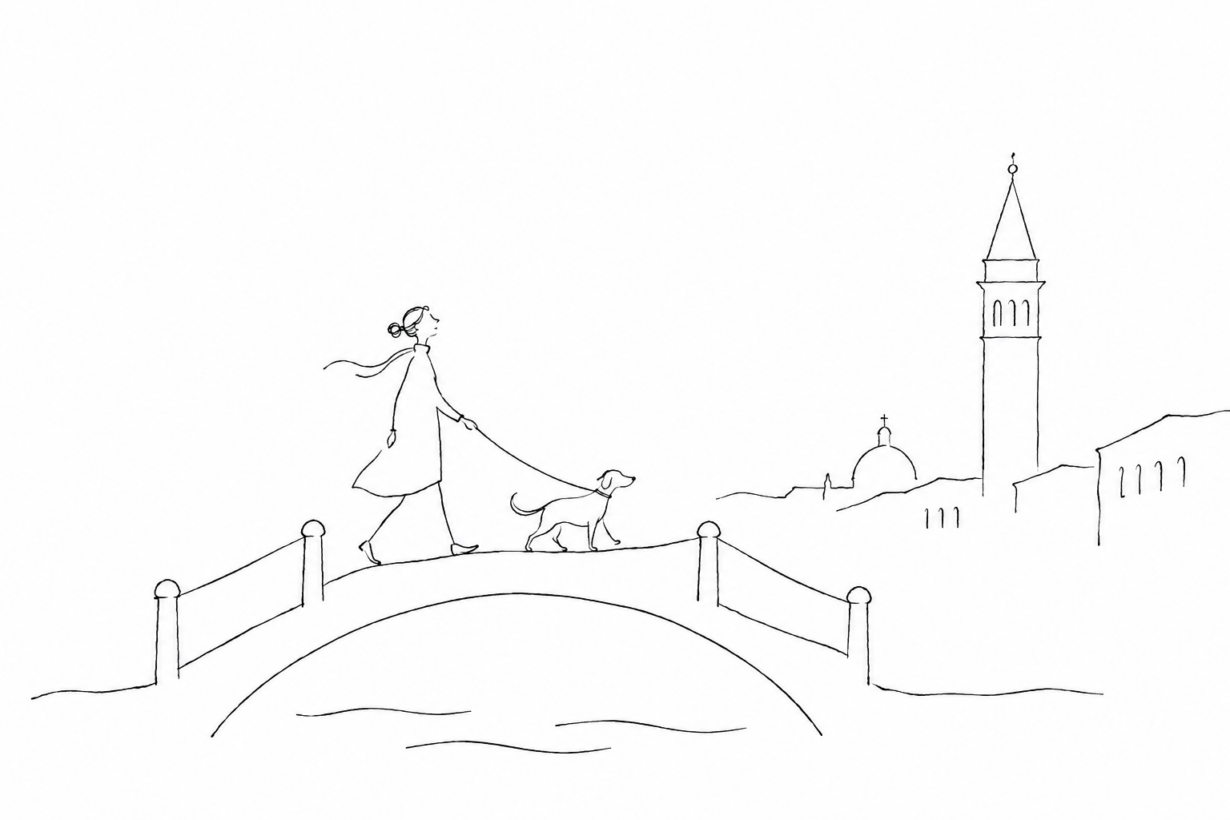
Venice is a surprisingly convenient city for anyone walking with a dog: no car traffic in the historic center, many airy fondamenta along the canals and short trips from one sestiere to another. The less obvious part, however, is the bridges. Closely spaced steps, narrow walkways, crowded calli and Istrian stone slippery after the rain impose a slower pace, especially with elderly dogs, puppies or dogs not very used to crowds.
Before leaving, it is worth preparing a simple but complete kit: water, collapsible bowl, bags, short leash, muzzle and health documents. The muzzle is not needed only “in theory”: it may be required on public transport and in very crowded situations. Better to have it at hand, already familiar to the dog.
The critical point is not visiting Venice, but choosing when to cross the busiest nodes. Between Rialto, St. Mark’s and the main landing stages, the central hours can become tiring: queues, compact groups, the noise of carts and little space to stop. Early morning, late afternoon and side routes make the city much more manageable.
ACTV water buses, trains and People Mover: rules for traveling
To get around Venice with a dog, the important distinction is not between “public transport yes” and “public transport no,” but between water transport, road vehicles, tram, train and People Mover. The rules change quite a bit, and knowing this beforehand avoids the classic problem at the stop, when you are already in the queue.
ACTV water buses: yes, but with leash and muzzle
On the ACTV water transport network, dogs can travel free of charge. The general rule provides for one dog per passenger, kept on a leash and with a muzzle; for small dogs, on water transport, the limit of one per passenger may be waived. In practice, the vaporetto is the most useful means if you want to connect distant areas without accumulating too many bridges: Piazzale Roma, Ferrovia, Rialto, St. Mark’s, Zattere, Giudecca, Lido and the islands are easier to reach by water than on foot.
However, it is worth thinking about the type of dog. The walkways of the landing stages move with the tide and the wave motion; some dogs cross them without hesitation, others freeze. It is better to keep the leash short when boarding and disembarking, let those in a hurry pass and get on when the sailor gives the go-ahead. At peak times, if the dog is large or not very used to tight spaces, it makes sense to choose a less crowded trip or wait in the airier area of the pontoon for the next vehicle.
ACTV buses and trams: pay attention in Mestre, Lido and the mainland
The rule changes on ACTV motor vehicles and trams: the transport of medium-sized or large dogs is not allowed, except for guide dogs for blind people. It is a decisive detail if you arrive or stay overnight on the mainland, or if you have to use buses and trams between Mestre, Marghera, Favaro, Piazzale Roma and other areas served by road. Before building an itinerary that depends on a bus, therefore, check whether the dog falls within the permitted conditions: what is possible on the vaporetto does not automatically transfer to the tram or bus.
On the Lido, where buses also circulate, the same caution applies: if you are traveling with a dog that is not small, the vaporetto often remains the simplest part of the journey, while the final stretch by road can be the real organizational constraint.
Trenitalia trains: ticket, documents and muzzle
Anyone arriving in Venice by train must consider the Trenitalia rules. Each passenger may travel with a dog of any size, as long as it is kept on a leash, has a muzzle and is accompanied by the relevant travel ticket when required. On Regional trains, the ticket for the dog costs 50% of the ordinary second-class fare, with possible exceptions indicated in the Official Timetable.
Also bring with you registration with the dog registry and the health booklet: they are not “long-trip” details, but documents required for transport. At Venezia Santa Lucia, the exit from the station leads directly onto the Grand Canal: beautiful, but often crowded. If the dog gets agitated among suitcases, steps and people standing still to take photos, it is better to prepare the muzzle and leash before getting off the train, not on the platform.
People Mover: useful, but watch out for escalators
The People Mover connects Piazzale Roma, Tronchetto and the Marittima area. It is practical if you arrive by car at Tronchetto or if you move around the terminal area, but with a dog there is a very concrete rule: in the stations, on escalators, the dog must always be held in your arms. It is not just a formality; escalators are uncomfortable and potentially risky for paws, nails and leash.
If the dog is heavy or does not let itself be lifted easily, use fixed stairs or elevators, present in the stations. It is one of those cases in which the “fastest” route on paper is not necessarily the most convenient: in Venice, with a dog, the choice of transport matters almost as much as the destination.
Dog-friendly museums? The rules between MUVE and Peggy Guggenheim
In Venice, the cultural visit with a dog should be organized before arriving at the ticket office: many museum interiors are not accessible to animals, even when the courtyard or atrium seems spacious. In the Civic Museums of Venice, that is the MUVE system which includes highly requested venues such as the Doge’s Palace, Museo Correr, Ca’ Rezzonico, Ca’ Pesaro and Palazzo Mocenigo, the regulations do not allow animals to enter. Exceptions are guide dogs for blind people and service dogs assisting people with disabilities.
The practical solution, if you want to visit a MUVE venue without giving up the program, is the MUVE dog friendly service: a dog-sitting service bookable via web or app, created with Bauadvisor, with handover at the museum entrance and return at the end of the visit. It is particularly useful for the Doge’s Palace, where between institutional rooms, prisons and internal passages, the stay can take time and is not suited to “quick” entrances.
A similar rule applies at the Peggy Guggenheim Collection, at Dorsoduro 701: animals are not allowed, except for guide dogs and certified therapy animals. Here too, the possibility of booking a dog sitter through Bauadvisor is indicated. In concrete terms, the visits that work best are those planned in advance: one important museum a day, booking the service when needed and generous timing to return without running between calli, bridges and landing stages.
Walks, dog areas and stops in the sestieri
For a day without strain, it is worth building the itinerary around the airier sestieri, leaving St. Mark’s and Rialto for quick passages. Cannaregio works well in the morning: the fondamenta between Ormesini, Misericordia and Madonna dell’Orto allow frequent breaks and fewer changes in level. Dorsoduro is suitable in the cooler hours, especially along the Zattere, where the space in front of the Giudecca Canal helps to keep distance from the crowd.
Castello offers one of the most comfortable routes eastward: via Garibaldi, the avenues of the Giardini and Sant’Elena give breathing room, with greener stretches than the monumental center. Santa Croce, between San Giacomo dall’Orio and Rio Marin, is useful for breaking up the route between the station, Piazzale Roma and the center without immediately slipping into the densest calli.
For real breaks, do not rely on chance: the Municipality of Venice publishes the list of municipal off-leash areas, to check according to the area you are in. If you plan a half day at the Lido, there is also a municipal beach for pets: the Pet’s Beach Area, 160 meters long, is accessible from via Pigafetta.
Bacari chapter: many places evaluate based on space and crowding. Ask first, choose outdoor tables when there are any and aim for short stops: some shade, water, two cicchetti, then back on the move.
Visiting Venice with your dog is above all a matter of rhythm: choosing the right hours, not cramming in too many consecutive stops and accepting a few intelligent detours. The city rewards those who walk carefully, because just outside the most crowded axes, quiet waterfronts appear, campi where you can stop for a moment and routes that tell of a less compressed Venice. Before leaving, always check the updated rules for transport, museums and municipal services: they change more often than you might think. With a little preparation, the trip remains simple, concrete and pleasant, even for those moving on four paws.