
Entering a bacaro without knowing how to move around can be disorienting: a full counter, people standing, cicchetti that disappear quickly and Venetian words used naturally. The good news is that there is no need to complicate things. You just need to understand what you are ordering, how to read the counter and how much it is worth taking so as not to turn a simple stop into a confusing bill. This guide starts from there: from the practical act of choosing a bite and a glass, with some useful coordinates for distinguishing a well-made break from a tasting taken at random.
Cicchetti, bacaro and ombra: the right words
Before getting to the counter, it is worth clarifying the vocabulary, because in Venice these words are not simple synonyms for aperitif. The bacaro is a small Venetian osteria: a place for a short stop, a quick conversation, a glass in hand and something to eat without turning everything into a seated lunch. It is not necessarily elegant nor rustic by definition; what matters rather is the direct relationship with the counter and with what is prepared during the day.
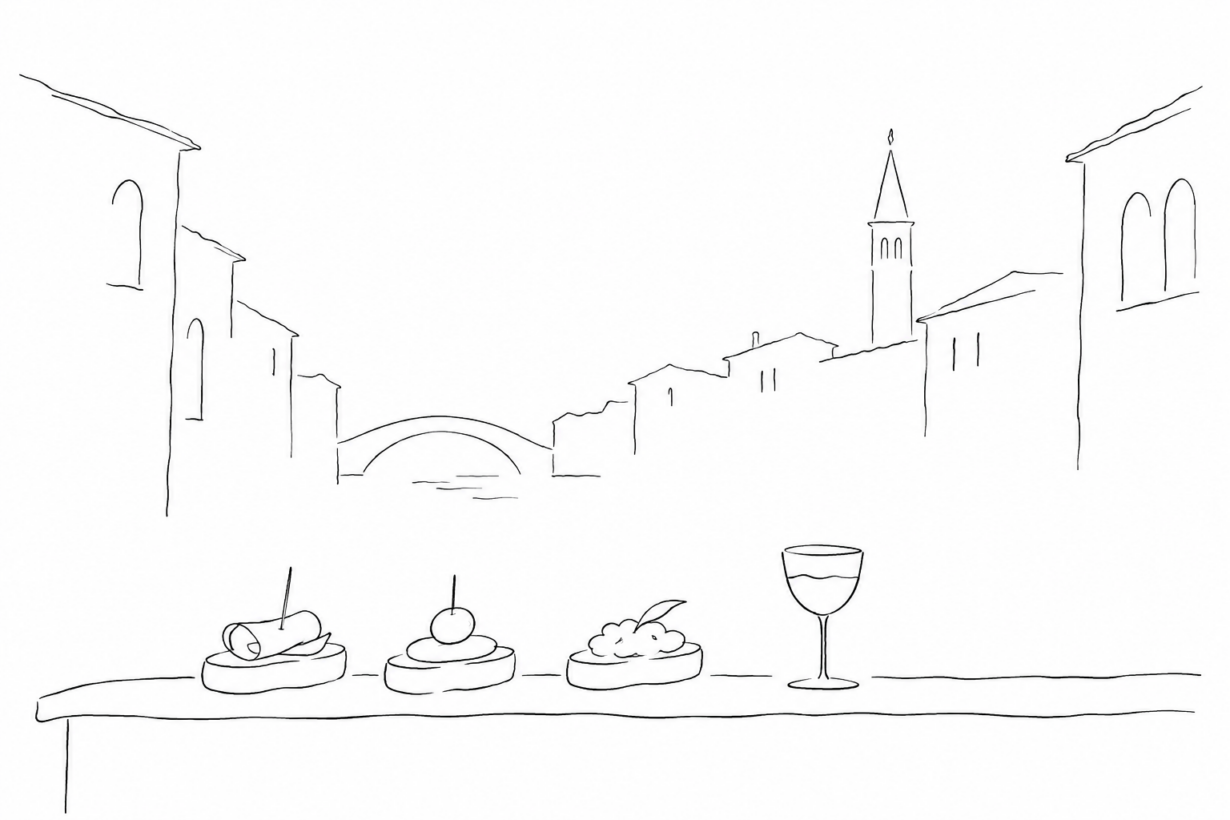
Cicchetti, or cicheti in the spelling closer to local usage, are hot or cold bites. Be careful: they do not coincide only with crostini and stuffed bread. They can be tastes to be taken with your fingers, small fried foods, plated preparations in reduced format, portions designed to accompany wine and to leave room for a second stop.
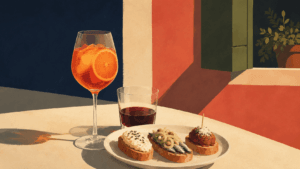
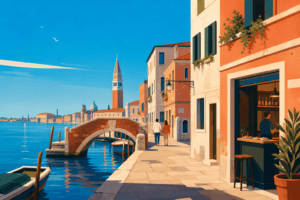
The ombra, instead, is the glass of wine. The Venice Unica tourist guide recalls this traditional use and connects the bàcari, or bàcaret, to the expression far bàcara, that is, to party, more than to a direct derivation from Bacchus. Knowing these three words helps you read the place: you do not enter “for Venetian tapas,” but for an urban ritual made of counter, measure and movement.
What to order: from baccalà to meatballs
In front of the counter it is best to think in terms of balance, not quantity. A good round of cicchetti mixes fish, meat and vegetables, alternating cold and hot bites: this way you understand the bacaro’s cuisine better and avoid filling up right away with three similar crostini.
The most Venetian starting point is often baccalà mantecato: creamed stockfish worked with oil until it becomes soft, usually served on bread or polenta. It has a decisive but not aggressive flavor, and it is useful as a first taste because it tells well the city’s historic relationship with preserved fish. Alongside it, if present, the sarde in saor deserve attention, prepared with onion, vinegar, raisins and pine nuts: sweetness and acidity together, born as a preservation technique and becoming one of the lagoon’s most recognizable flavors.
Do not stop only at fish, however. Meatballs are a serious category: meat, tuna, vegetables, fried and served hot when the counter is turning over well. The most cited reference remains Alla Vedova, that is the Trattoria Ca’ d’Oro in Cannaregio 3912, also known for its historic meatball; it is a useful example because it clarifies how much this bite, apparently simple, is an integral part of the bacaro lexicon.
- To start: baccalà mantecato and a sarda in saor, if available.
- To vary: a crostino with fish, a hot meatball, a fried or marinated vegetable.
- To observe: what is coming out of the kitchen at that moment: often the best cicchetto is the one just replenished.
Fried foods should be chosen carefully: mozzarella in carrozza, vegetables, small fish bites or meatballs do best hot and dry. Crostini, instead, allow more imagination: creams, cured meats, anchovies, cheeses, radicchio or seasonal ingredients. The ideal order is not a fixed list, but a small readable combination: something from the sea, something substantial, something vegetable.
How the bacaro counter works
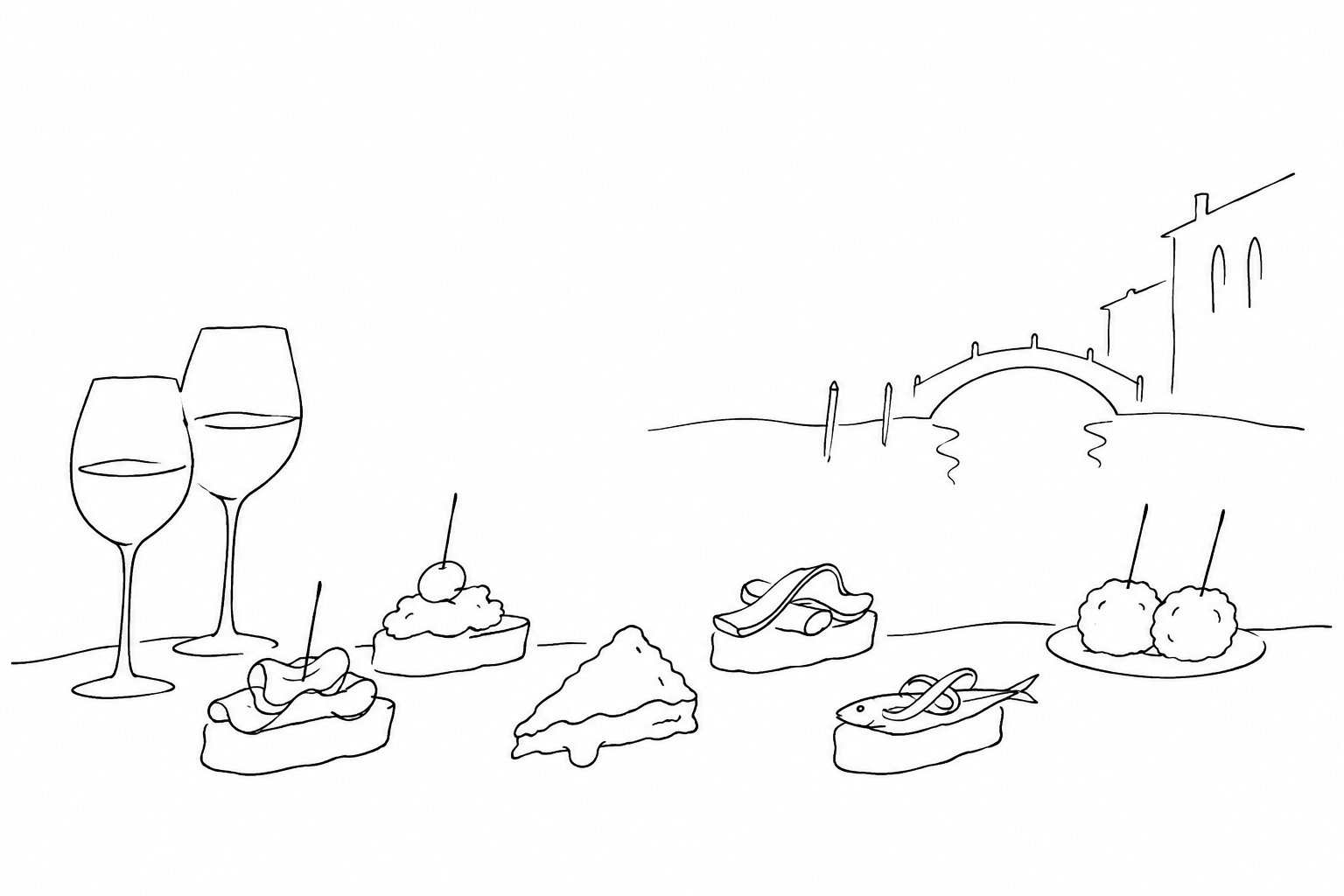
In a bacaro you do not sit down to study a long menu: you enter, let those leaving pass, and look at the counter. That is where you understand what is worth taking at that moment. The cicchetti are displayed in trays, pans or plates behind the glass; some are already ready, others can be heated on the fly. You order by indicating the pieces chosen, preferably decisively but without haste: “one of that,” “two meatballs,” “an ombra” are perfectly normal formulas.
The practical rule is to order a little at a time. Two or three tastes and a glass are enough to start; if the counter continues to turn over, you can add more. In the smallest places, space is part of how it works: you consume at the counter, on narrow shelves, standing in front of the entrance or outside, only where it is allowed and without blocking calli and bridges. In Venice, the passage is truly narrow, not just a manner of speaking.
If the price list is not clearly visible, it makes sense to ask first how much the individual cicchetti and the chosen glass cost. It is not rude: it avoids misunderstandings, especially when ordering several pieces for a group. At the end you pay at the cashier or directly at the counter, according to the place’s habit; it is worth remembering what you have taken, because the pace can be fast and the staff are serving many people at once.
How much you spend and where it makes sense to stop
To understand how much you really spend, the safest rule is to look at the prices displayed before ordering. In Venice the bill can change by area, type of place and mode of consumption: standing at the counter, leaning outside or sitting at the table are not always the same thing. The Venice Unica tourist guide showed cicchetti and sandwiches at €1.50, but it should be read as a historical snapshot, not as a current price list.
A concrete reference helps with orientation: Gambero Rosso indicates Alla Vedova, the Trattoria Ca’ d’Oro in Cannaregio 3912, as an address famous for its meatball, listed at €2.50 apiece at the table. It is a useful figure because it shows how much both the name of the place and the service matter.
Where should you stop, then? It makes sense to choose counters with clear labels, good tray rotation and a clientele that consumes without occupying the place for long. Transit areas such as Rialto are convenient but often more crowded; Cannaregio, San Polo and Dorsoduro allow you to alternate well-known addresses and more practical stops. Better to make a small first order, check quality and bill, then possibly continue.
The bacari tour works best when it stays light: a few tastes, attention to the counter, an eye on prices and the willingness to change address if the place is too full. Cicchetti are not a folkloristic shortcut to “eating Venetian,” but a concrete way to understand the city’s rhythms, tastes and habits. Ordering well also means not turning every stop into a list to tick off: it is enough to recognize what is worth tasting, respect the pace of the counter and leave room for curiosity. Venice, in this, rewards those who observe before asking.