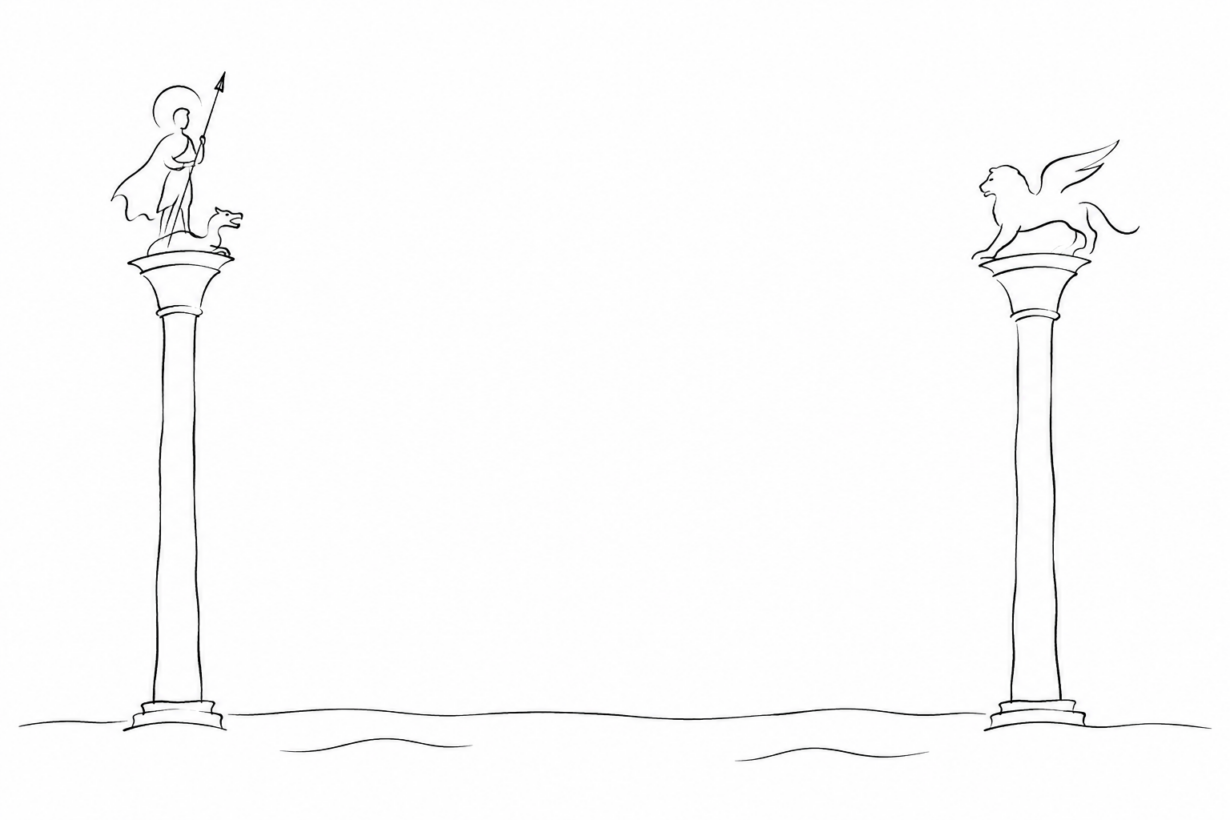

Among the best-known symbols of Venice there is one that works almost in silence. The column of Saint Theodore stands near the lion of Saint Mark, but tells a different story: that of the saint whom Venetian tradition links to the oldest phase of civic worship, before the evangelist became the dominant emblem of the Republic. Looking at it closely means adding a layer to a visit to the Piazzetta, beyond the classic photograph. You do not need to be a specialist: you just need to know where to stand, what to observe above and why that soldier saint with the dragon deserves more attention than he usually receives.
Where the column of Saint Theodore is
The column of Saint Theodore is in the Piazzetta San Marco, on the side of the quay, right next to the more famous column with the winged lion. If you arrive from the San Marco Basin, that is, from the water, the two columns still mark a kind of monumental threshold today: behind them the Piazzetta opens up, in front are the lagoon, San Giorgio Maggiore and the continuous traffic of vaporetti and motorboats.
The point is simple, but often escapes notice: those walking toward the Doge’s Palace tend to focus their gaze on the lion, on the Gothic façade or on the Basilica. Saint Theodore remains there beside them, quieter, and precisely for this reason it is worth stopping before crossing the Piazzetta. Looking at him right away helps you read Venice not only through its best-known symbol, Saint Mark, but also through an older trace of its civic identity.
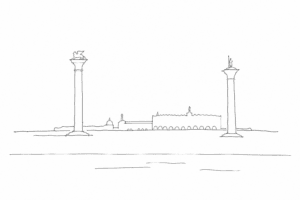
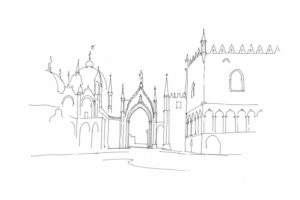
To orient yourself, stand with the Basin behind you: the column of Saint Theodore is the one toward the Doge’s Palace. At the top you will see the figure of the saint above the capital; a few meters away, on the other column, the lion dominates the scene.
The patron before the lion of Saint Mark
Before the winged lion became the immediately recognizable sign of Venice, Saint Theodore had an important place in the city’s civic worship. This is the point that makes his column so interesting: it is not only the less photographed “neighbor” of the lion, but the memory of an older phase of Venetian identity.
Saint Theodore was a soldier saint greatly venerated in the Byzantine area. For a Venice still culturally and politically tied to the East, his figure made sense: he spoke a familiar religious language, close to the world from which the lagoon city drew models, trade and prestige. Venetian tradition in fact presents him as an ancient patron, later joined and progressively overshadowed by Saint Mark.
The change in balance occurs with the construction of the myth of Saint Mark: the arrival of the evangelist’s relics from Alexandria, in the 9th century, offers Venice a patron of apostolic rank and a more powerful symbol to represent the Republic. Over time the lion of Saint Mark does not remain only a religious emblem: it becomes the image of the State, appearing on flags, coins, seals, public buildings and territories subject to Venice.
One thing must be stated precisely, however: Theodore’s absolute primacy as the “first patron” is debated by historians. A strong devotion and the existence of a sacred building dedicated to him in the Marcian area are documented, but the exact chronology in relation to Saint Mark’s Basilica is not so linear. It is precisely this uncertainty that makes the column less simple and more precious: it preserves a civic memory prior to the triumphant narrative of the lion.
What the statue at the top of the column represents
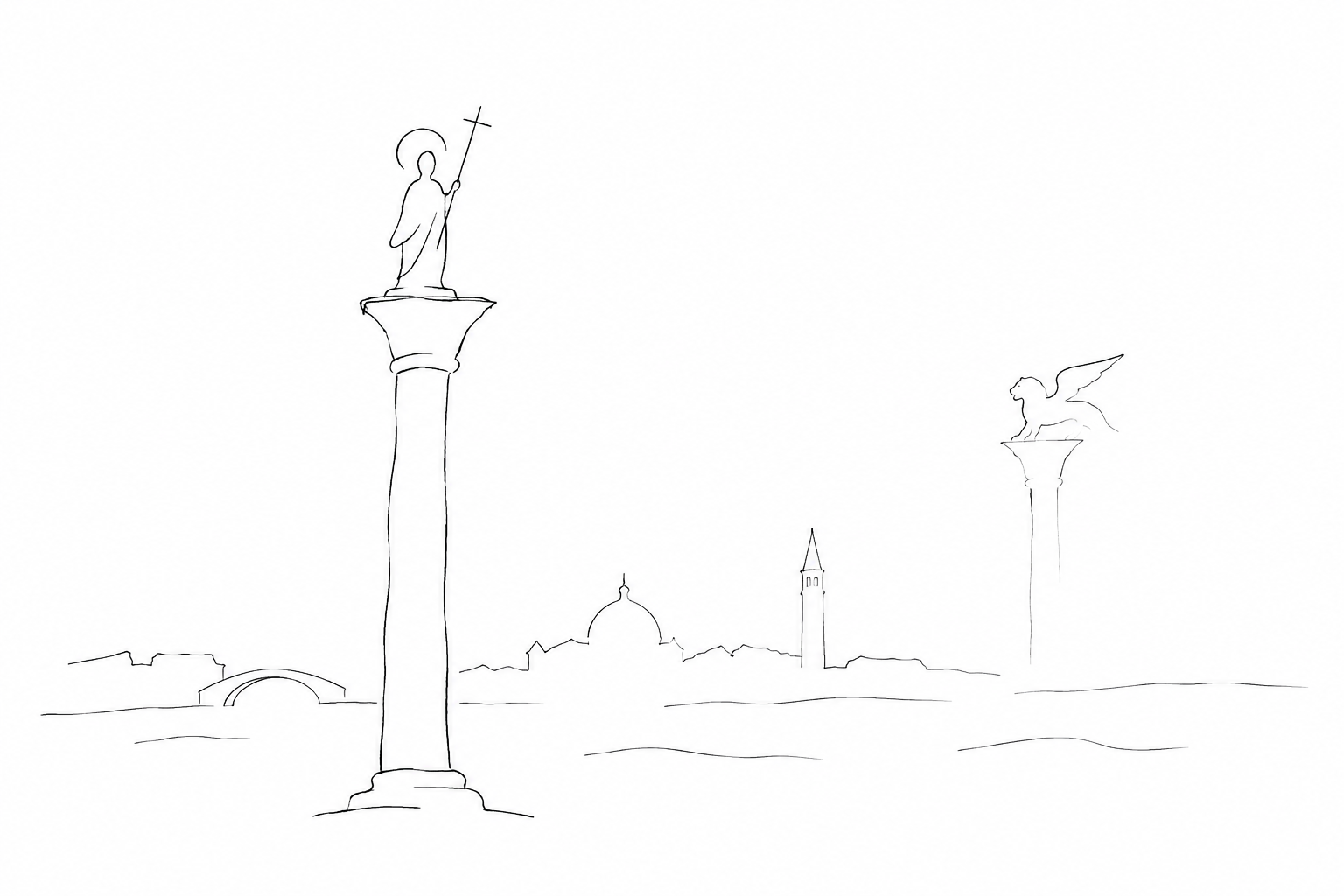
The group at the top should be read from bottom to top. First there is the shaft, a monolith of eastern granite that raises the figure well beyond the scale of people; then the Veneto-Byzantine capital, more worked, which functions like a small ceremonial platform. Only after that comes Saint Theodore, or Tòdaro, as he is called in the city.
The statue presents him as a Byzantine soldier saint: not a bishop, not a hermit, but an armed figure, standing above the defeated monster. It is a very direct image. The dragon beneath his feet represents evil overcome, according to a symbolic language easy to recognize even without reading inscriptions. Looking at it closely, however, the monster does not have the orderly appearance of the textbook medieval dragon: it seems like a hybrid creature, almost crushed, and precisely this strangeness makes the scene more interesting.
The message was clear for those entering from the Basin: the saint protects, fights, dominates chaos. Placed beside the winged lion, Theodore appears less powerful today on a symbolic level, but his posture preserves an older strength, linked to the Byzantine and military world.
An important detail: the figure displayed outdoors is identified as a copy. The original is kept at the Doge’s Palace, an understandable solution for a work so exposed to wind, salt and bad weather.
How to observe it today in the Piazzetta
To see it well you do not need to book anything: the column is in a public space, visible for free, without a ticket and without opening hours. The point, if anything, is to choose the right distance. If you stand right under the shaft, the statue flattens against the sky and you lose the capital; it is better to step back toward the center of the open space between the quay and the façades, also letting the lion’s column enter your view.
Light makes the difference. In the middle hours the marble tends to become a pale silhouette; with more raking light, in the morning or late afternoon, the profile of the saint, the monster beneath his feet and the volumes of the Veneto-Byzantine capital can be read better. A small pair of binoculars, or the phone zoom used calmly, helps more than a photograph taken in passing.
If you enter the museum route of the Doge’s Palace, with access from the Porta del Frumento, San Marco 1, look for the views from the loggias toward the space of the columns. From there everything changes: Saint Theodore and the lion no longer appear isolated, but as two signals placed to guard the passage between water, civic power and the Marcian area.
Once Saint Theodore has been identified, the Piazzetta reads differently. The lion remains the powerful and immediate symbol of Venice, but that more secluded figure recalls that the city’s identity was not born already complete: it was built through passages, substitutions, preserved memories and others almost erased. A few minutes are enough, preferably without haste, to give meaning to a column that many people cross with their gaze without really seeing it. It is one of those Venetian details that do not ask for detours, tickets or great explanations on site: they ask only for attention.