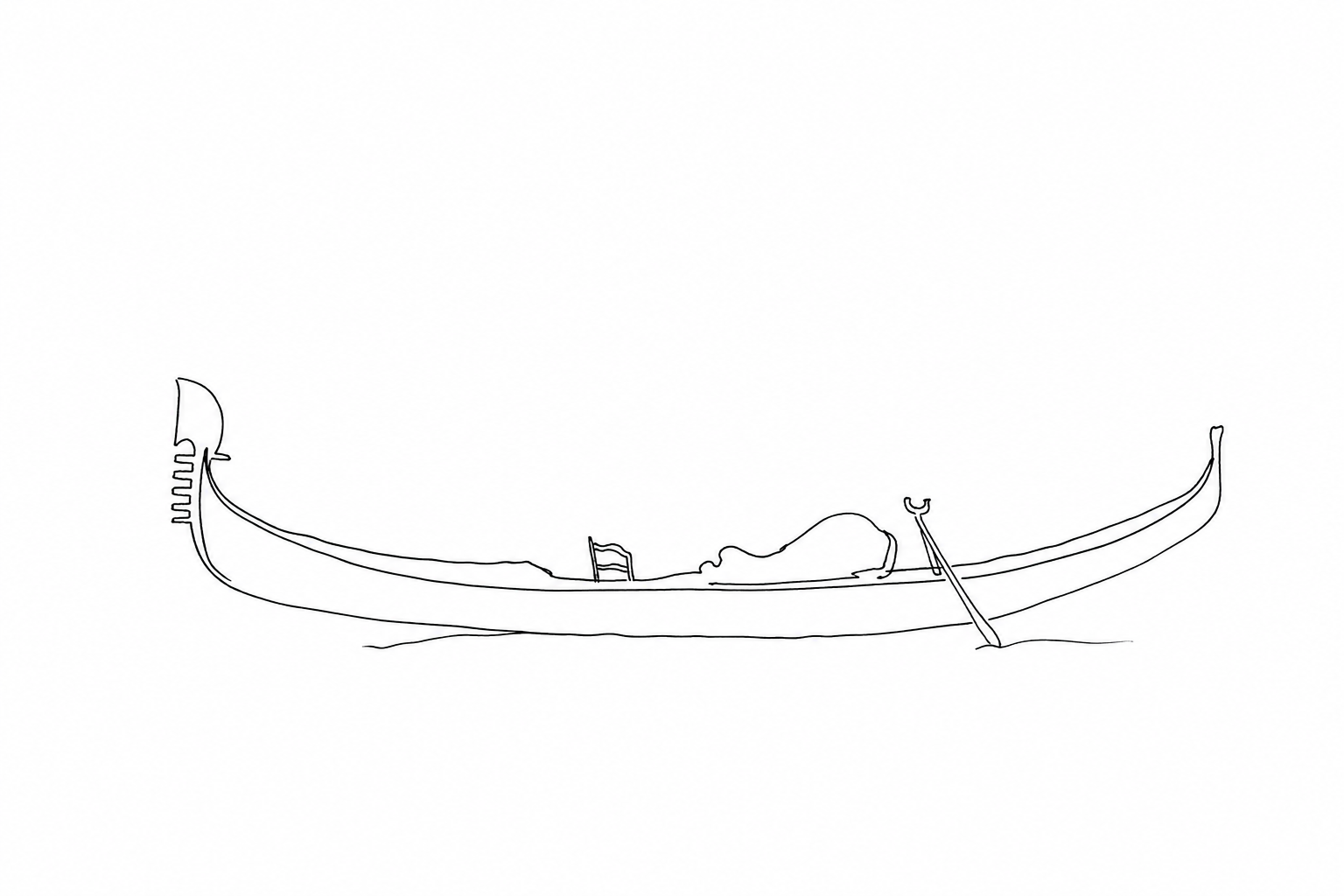

The gondola is one of Venice’s most recognizable objects, but observing it only as an icon means missing its most interesting part. Every element arises from a necessity: moving through narrow rii, balancing the weight of the gondolier, dealing with turns, currents and irregular landings. The bow ferro, the asymmetrical line of the hull, the position of the oar and the small construction details tell of a boat designed first and foremost to function. Looking at it up close, along a canal or beside a squero, makes it possible to read a concrete fragment of the city: technique, craft and daily habit intertwined in a form that is elegant only in its apparent simplicity.
A boat designed for the rii, not for scenery
The gondola was not born as a romantic image of Venice, but as a technical response to a water city made up of narrow rii, sudden bends, shallow bottoms and irregular landings. Each of its parts serves to move in this environment: the long, thin hull reduces friction, the almost flat bottom allows it to advance where there is little water, the raised bow helps it overcome the small wave motion of the canals.
The most important detail is asymmetry. The gondola is not perfectly the same on both sides: it is slightly deviated to compensate for the thrust of the gondolier, who rows standing on only one side. Without this correction, the boat would tend to turn continuously. The bow ferro too, often mistaken for ornament, has a function: it balances the weight of the oar and the rower at the stern, protects the bow when coming alongside and makes the orientation of the craft readable. Beauty, here, derives from necessity.
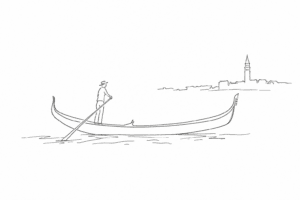
The bow ferro: symbol, counterweight, reading of the city
The ferro, also called fero da prova in Venetian, is one of the most recognizable parts of the gondola, but its shape should not be read as a simple frieze. The metal blade applied at the front adds weight at a strategic point and helps compensate for the thrust of the gondolier, who rows from the stern and on only one side. In a boat already built with a slight asymmetry, this element also contributes to the overall balance.
Its silhouette also functions as a small symbolic map of Venice. Tradition interprets the six teeth pointing forward as the city’s six historic sestieri; the tooth pointing backward is often associated with the Giudecca. The upper curve recalls the ducal horn, while the sinuous course of the shaft can evoke the Grand Canal. These are layered readings, not technical instructions, but they explain why the ferro has become a marker of identity: in a few centimeters it concentrates nautical function, political memory and urban geography.
The asymmetry of the hull and the gesture of the oar
The gondola is not perfectly symmetrical: seen from above, the hull is slightly curved to the left. This choice, consolidated by Venetian shipwrights, compensates for the fact that the gondolier rows while standing on the right side, with a single oar resting on the forcola.
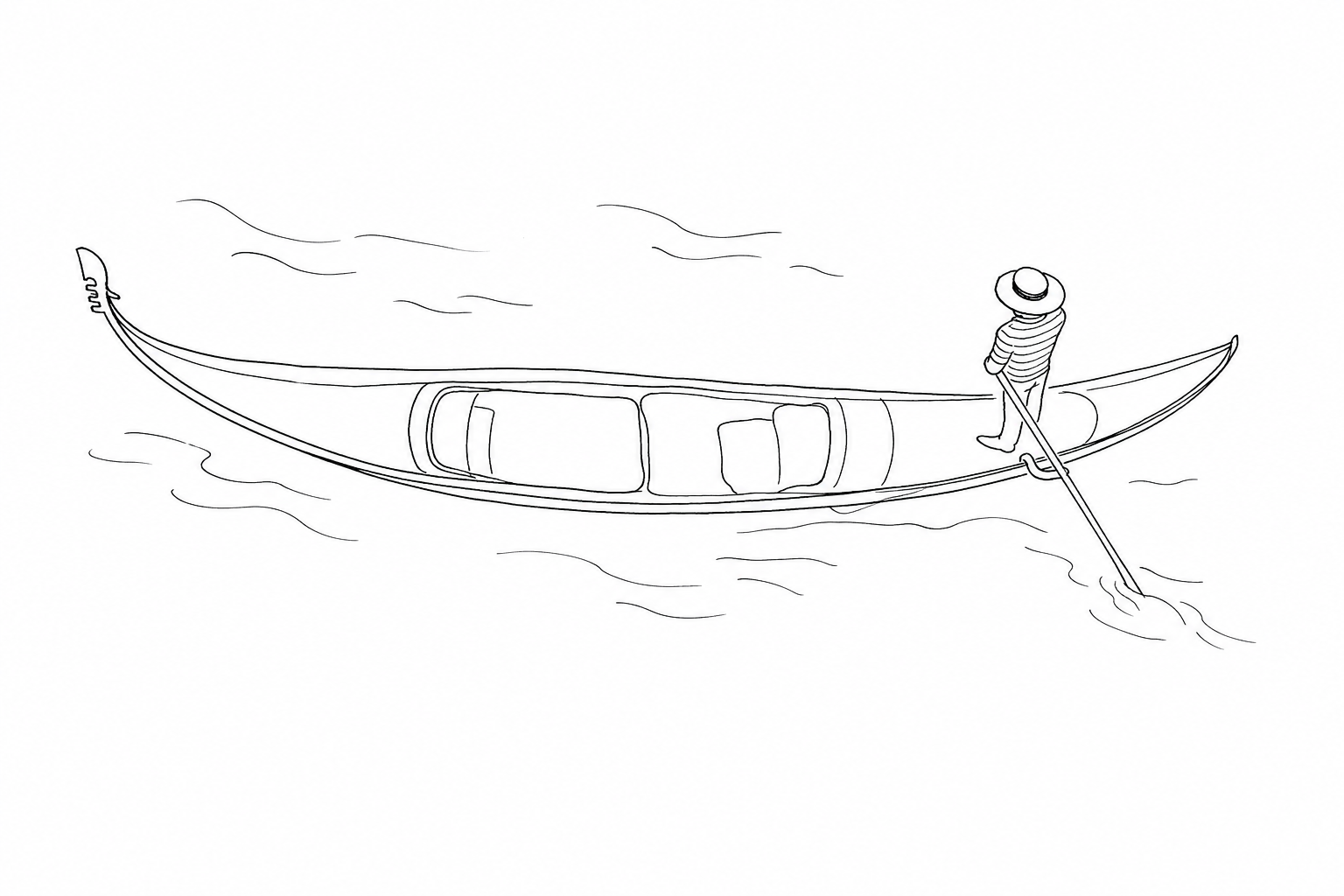
If the hull were balanced symmetrically, every stroke would tend to make the craft rotate. Instead, the shifted longitudinal line and the different curvature of the sides generate a continuous correction: the lateral thrust of the oar is absorbed by the very shape of the boat, which can move straight ahead without a rudder.
The gesture is therefore not a simple back-and-forth movement. Venetian rowing alternates pressure, recovery and small rotations of the wrist; the blade works in the water at different angles, while the forcola offers multiple support points. That shaped piece of wood too is a technical tool: it allows accelerations, braking, tight turns and reversals in the narrowest rii.
Asymmetry, invisible to many passengers, is therefore an essential part of balance: it transforms a lateral oar stroke into a controlled trajectory.
Functional details to observe along the canals
To truly read a gondola, it is worth looking at what seems like ornament but arises from use. The forcola, usually carved from walnut, is not a simple support: its curves offer the oar different points, allowing forward movement, braking, reverse and brief rotations. Each hollow corresponds to a gesture by the gondolier.
- The front metal blade protects the end and balances the weight of the rower positioned at the stern; its shape has also become a heraldic and urban sign.
- The black bands and profiles highlight joints, edges and parts exposed to impacts against banks, poles and other boats.
- The oar, long and light, works freely: it is not fixed, precisely in order to change angle and pressure quickly.
- The raised deck and the internal seats distribute weights, an essential detail in a narrow hull.
Observed from the bridges, these elements tell of a slow, precise technology adapted to the Venetian rii.
Understanding how a gondola is made changes the way you look at it passing by. No longer a simple Venetian backdrop, but the result of precise adaptations, settled over time and still readable in its profiles. The ferro is not merely ornament, asymmetry is not an imperfection, the details are not decoration: they are practical responses to a water city, narrow, mobile, complex. The next time a gondola brushes a bridge or turns into a side rio, it is worth pausing over these signs. In that silent maneuver one recognizes a less exhibited and more concrete Venice, made of balance, measure and knowledge of the place.
Related Posts
The Venetian remèr: oars and forcole, the craftsmanship without which the gondola does not move
Who the Venetian remèr is, how oars and forcole are made, and why the movement of the gondola depends on these pieces.The mascareta: small, agile and Venetian, long before the regatta photos
History and use of the mascareta, a light boat created for rii, canals and the lagoon.
The squero of San Trovaso: the gondola boatyard that seems to come from Cadore
History, form and function of the squero of San Trovaso, the Dorsoduro boatyard with an Alpine-house façade.Questions Answered
Why is the gondola asymmetrical?
It compensates for the gondolier's single-side rowing to maintain balance.What is the functional purpose of the bow ferro?
It balances weight, protects the bow, and represents Venice's sestieri.How does the gondolier row effectively?
Using forcola's multiple supports and wrist rotations to navigate.What details on a gondola serve practical uses?
Black bands, raised deck, and a flexible oar improve durability and control.
Keep reading Venice from the boats
Want to understand Venice through boatyards, oars and vessels rather than only from the waterfront?
 The Venetian remèr: oars and forcole, the craftsmanship without which the gondola does not moveWho the Venetian remèr is, how oars and forcole are made, and why the movement of the gondola depends on these pieces.
 The squero of San Trovaso: the gondola boatyard that seems to come from CadoreHistory, form and function of the squero of San Trovaso, the Dorsoduro boatyard with an Alpine-house façade.
 Traghetto da parada: crossing the Grand Canal like Venetians doWhat the traghetto da parada is, how to use it, and why it tells of the everyday relationship between Venice, water, and...
 The caorlina: the transport boat that became a protagonist of historic regattasOrigins, shape and role of the caorlina: from a working boat of the lagoon to a symbolic presence in Venetian regattas.